Showing posts with label Social Justice. Show all posts

Monday, 2 November 2015

"Just" Christmas, Nov 15

The 2015, 8th annual event will take place on NOVEMBER 15TH from 1-3:30 at
     Gordon-King Memorial United Church, 127 Cobourg Avenue in East Kildonan.
You’re welcome to come get your Christmas shopping done in Just one Place all for Just causes and with Justice focused organizations. 
Check out all the vendors! Including us at 1JustCity and watch for our catalogue online soon!

Monday, 7 September 2015

Refugees Welcome Rally at Wpg City Hall

On Sunday, Sept 6, many gathered at City Hall to call for the opening of our doors to refugees.  Here are some pictures.
Raging Grannies

Pillows with messages:  Refugees Welcome and We Have Room

Group listening to member of Winnipeg's Syrian community

Refugee from Iran, who came at age 15 with Grade 2 education, now a law student at U of M

Noelle DePappe, who works withe refugees in Winnipeg

Candle-light vigil

Contemplative moment during vigil

Posted by Kathleen and Gareth

Tuesday, 28 July 2015

Churches for Freedom Road


Augustine United Church has joined many other churches in using their signs to call for justice for the Shoal Lake 40 First Nation.  This is part of a larger effort to apply pressure on the federal government to build an all-season access road, so that Shoal Lake's 17 year boiled water advisory can be lifted.  Go to their website for more information.

I'm a little disappointed that the initiative is being called "Churches" for Freedom Road, since I'd heard early on that there was interest from mosques, synagogues and temples to participate in this call for justice.  Not sure what happened to that.  As it stands, it would be unlikely for some of these other faith communities to join up, given the name of the initiative.  


- Submitted by Gareth

Tuesday, 31 March 2015

"Boycott Driscoll's berries!" - Farmworkers


From Treehugger.com
Until their employer agrees to negotiate fairly, farmworkers in Washington state want consumers to avoid all Driscoll's, Häagen-Dazs and Yoplait products that contain berries grown on the notorious Sakuma Brothers farm.
Farm workers in Washington state are fighting for fairer pay and better treatment, and they need support from consumers. These workers, who pick strawberries for the notorious Sakuma Brothers Berry Farm, have been subjected to a wide range of abuses for years, such as inadequate piece rates, systematic wage theft, racist and sexist abuse from supervisors, substandard housing, and continuous retaliation for their efforts to improve conditions.
The Sakuma Brothers berry farm, located in Burlington, WA, supplies strawberries to Driscoll’s, a familiar label to many consumers. Even here in faraway, still-wintry Ontario, Driscoll’s is the only brand of fresh strawberries available year-round at my local grocery store. Sakuma also sells berries to Häagen-Dazs and Yoplait.

Friday, 19 September 2014

Museum of Human Rights Opening and Idle No More

Biked past the Human Rights Museum about noon today. Opening ceremony had just ended when I got there, and I found myself in the middle of a little Idle No More action. And I made "friends" with three guys from Shoal Lake. Asked whether I could give them some "Where Waters Meet" propaganda (see "Faith in the City" information posted in this blog), which they happily accepted, in exchange for some "propaganda" of their own.


- submitted by Gareth

Saturday, 22 March 2014

Sold Aged 7 - For Chocolate

This was sent to me via my Sojourners email service.  Walk Free is a movement of people everywhere, fighting to end one of the world's greatest evils: Modern slavery.


In the cocoa fields of the Ivory Coast, child slavery is ‘normal.’ It’s routine. It’s accepted.1 Children as young as 7 are sold – deprived of their childhood, ripped from their families, and subjected to routine abuse – to work long, backbreaking days picking cocoa. And it all stems from our love of chocolate.

Many chocolate brands have made public commitments to find the best solution. But we’ve learned that Warner Bros. is refusing to tell consumers where the cocoa for their Harry Potter chocolates comes from.

Warner Bros. has just announced plans for a massive expansion of their Harry Potter World in Florida – including a new shopping district, where more children than ever will be able to buy these chocolates. Taking a stand right now will make a big impact – will you help?

Image Source:  Cargocollective.com


Thousands of activists have asked Warner Bros. to ensure their Harry Potter chocolates are free of slavery because:
  1. An independent investigation into their supplier Behr’s Chocolates led to a failing score of 1 out of 48 possible measures to ensure their operations are slavery-free;2
  2. Warner Bros. dismissed the findings of the investigation, simply stating that they were 'satisfied’ that fair labour practices were being used in the production of their chocolates;
  3. Given the conflicting information, outraged consumers asked Warner Bros. what steps were taken to ensure there was no slavery in Harry Potter Chocolates. Warner Bros. refused to respond.
We’re concerned that Harry Potter chocolates may contain cocoa harvested in conditions of modern slavery. Are you?


http://www.walkfree.org/wp-content/uploads/2013/05/Harry-Potter-website.png
Image Source:  Walkfree.org

 As consumers, we deserve to know that the products we buy are free from the taint of modern slavery. 


Ask Warner Bros. to ensure their Harry Potter Chocolate Frogs are free of slavery.

Thank you in advance for taking action. Please share this with your friends to bring us one step closer to ending the ‘normality’ of child slavery.

- submitted by Gareth

Thursday, 20 March 2014

News from International Labour Rights Forum


Last year, we brought you the story of Edwin Cisco, who together with the Firestone Agricultural Workers Union of Liberia (FAWUL) is changing the way rubber is tapped in Liberia--with assistance from ILRF and the support of concerned individuals like you. FAWUL and Edwin are powerful testimony that change can happen if we work together. We write now to ask you to help ILRF expand our work with Labor Rights Defenders.

Image Source:  ILRF
In the past ten years, Edwin Cisco has gone from being jailed for organizing to winning awards for his work to end child labor. And now agriculture workers across Liberia hope that FAWUL’s wins for workers can be expanded to all workers, across the industry. This is because FAWUL won ground-breaking changes in their most recent contract negotiation, securing reduced production quotas, agreements with Firestone to build more schools, and a transport system so rubber tappers no longer have to walk miles each day with 150 pounds of rubber on their backs!

These wins come after more than a decade of work by ILRF, FAWUL, and many others to improve working conditions on Firestone rubber plantations.

In the lead-up to recent union negotiations, ILRF developed with FAWUL a field survey to document workers’ living conditions and expenses and children’s access to schools. These surveys laid the foundation for FAWUL's wins, improving life for 6,400 workers and their families -- all together helping more than 40,000 people! We have long advocated for a path to change like FAWUL’s -- one where parents and community leaders are making the eradication of child labor possible, by negotiating better livelihoods for parents and holding corporations accountable for conditions in their supply chains.
Our ability to foster solidarity across countries depends on individuals like you -- who understand that a violation of one worker's rights undermines all workers’ rights. Please consider making a donation today so we can continue to support front line labor rights defenders around the globe.

In solidarity,

Judy Gearhart
Executive Director


- Submitted by Bev

Worse than Walmart:

Amazon’s sick brutality and secret history of ruthlessly intimidating workers 

You might find your Prime membership morally indefensible after reading these stories about worker mistreatment
From Salon.com, February 23, 2014
Written by Simon Head

Excerpted from the book "Mindless:  How Smarter Machines are making Dumber Humans"

When I first did research on Walmart’s workplace practices in the early 2000s, I came away convinced that Walmart was the most egregiously ruthless corporation in America. However, ten years later, there is a strong challenger for this dubious distinction—Amazon Corporation. Within the corporate world, Amazon now ranks with Apple as among the United States’ most esteemed businesses. Jeff Bezos, Amazon’s founder and CEO, came in second in the Harvard Business Review’s 2012 world rankings of admired CEOs, and Amazon was third in CNN’s 2012 list of the world’s most admired companies. Amazon is now a leading global seller not only of books but also of music and movie DVDs, video games, gift cards, cell phones, and magazine subscriptions. Like Walmart itself, Amazon combines state-of-the-art CBSs with human resource practices reminiscent of the nineteenth and early twentieth centuries.

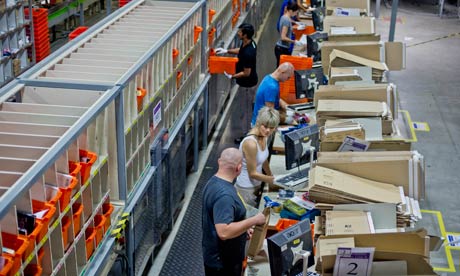
Amazon equals Walmart in the use of monitoring technologies to track the minute-by-minute movements and performance of employees and in settings that go beyond the assembly line to include their movement between loading and unloading docks, between packing and unpacking stations, and to and from the miles of shelving at what Amazon calls its “fulfillment centers”—gigantic warehouses where goods ordered by Amazon’s online customers are sent by manufacturers and wholesalers, there to be shelved, packaged, and sent out again to the Amazon customer.


http://bbpbooks.teachingforchange.org/files/teachingforchange/amazonwarehouse.jpg
Amazon’s shop-floor processes are an extreme variant of Taylorism that Frederick Winslow Taylor himself, a near century after his death, would have no trouble recognizing. With this twenty-first-century Taylorism, management experts, scientific managers, take the basic workplace tasks at Amazon, such as the movement, shelving, and packaging of goods, and break down these tasks into their subtasks, usually measured in seconds; then rely on time and motion studies to find the fastest way to perform each subtask; and then reassemble the subtasks and make this “one best way” the process that employees must follow.

...

In December 2009 Mark Onetto, chief of operations and customer relations at Amazon and a close collaborator of Bezos, gave an hourlong lecture on the Amazon Way to master’s of business administration students at the University of Virginia’s Darden School of Business. Onetto is a disconcerting figure, because once he starts talking, style and substance are in sharp contrast. He is French born, and he still speaks with the rather faded insouciance of Maurice Chevalier and “Gay Paree,” and he makes much of this in his lecture. But there was nothing gay (in the traditional sense) or insouciant about the Amazon workplace that Onetto described for UVA’s MBA candidates.

Like most such corporate mission statements, Onetto’s uses a coded language that hides the harshness of his underlying message, which needs translation along with a hefty reality check. As with Walmart so at Amazon, there is a quasi-religious cult of the customer as an object of “trust” and “care”; Amazon “cares about the customer,” and “everything is driven” for him or her. Early in the lecture, Onetto quotes Bezos himself as saying, “I am not selling stuff. I am facilitating for my customers to buy what they need.”

...

Whereas some Amazon employees are in constant motion across the floors of its enormous centers—the biggest, in Arizona, is the size of twenty-eight football fields—others work on assembly lines packing goods for shipping. An anonymous German student who worked as a temporary packer at Amazon’s depot in Augsburg, southern Germany, has given a revealing account of work on the line at Amazon. Her account appeared in the daily Frankfurter Allgemeine Zeitung, the stern upholder of German financial orthodoxy and not a publication usually given to accounts of workplace abuse by large and powerful corporations. There were six packing lines at Amazon’s Augsburg center, each with two conveyor belts feeding tables where the packers stood and did the packing. The first conveyor belt fed the table with goods stored in boxes, and the second carried the goods away in sealed packages ready for distribution by UPS, FedEx, and their German counterparts.


Staff at Amazon's Marston Gate warehouse.
Image Source:  Sarah Lee, The Guardian
Machines measured whether the packers were meeting their targets for output per hour and whether the finished packages met their targets for weight and so had been packed “the one best way.” But alongside these digital controls there was a team of Taylor’s “functional foremen,” overseers in the full nineteenth-century sense of the term, watching the employees every second to ensure that there was no “time theft,” in the language of Walmart. On the packing lines there were six such foremen, one known in Amazonspeak as a “coworker” and above him five “leads,” whose collective task was to make sure that the line kept moving. Workers would be reprimanded for speaking to one another or for pausing to catch their breath (Verschnaufpause) after an especially tough packing job.

...

A significant portion of the article has been reposted here.  There's more.  You can read the entire article by clicking here.

Note:  It is not hard to find other articles critical of worker conditions at Amazon.com.  The book, Mindless, written by Simon Head and from which this is excerpted, focuses at least in part on abuses such as these.  You can read a short but excellent review of that book, by clicking here.  A quote from the review:  [Head] argues that ... computerized management programs that Amazon and other large organizations use to measure everything that happens in factories, warehouses and depots—are turning workers into “digital chain gang” members who work harder and earn less. Once limited to tracking blue-collar productivity, CBSs now engulf much of the white-collar world, where they control the complex work of physicians, teachers and others in the professional and administrative middle class.

-Submitted by Gareth

Social inequity vs. the environment is a false choice

It's time we stop pretending that inequality and environmental decline are two separate problems 

From Salon.com, March 16, 2014
By Annie Leonard, originally published in Earth Island Journal


Note:  Annie Leonard is an American proponent of sustainability and critic of excessive consumerism. She is most known for her animated film The Story of Stuff about the life-cycle of material goods.

Note 2:  Leonard makes reference to Wilkinson and Pickett.  If you  haven't seen the 17 minute TED talk by Richard Wilkinson called:  "How economic inequality harms societies", I highly recommend it.  You can find it by clicking here.

In this article, Leonard proposes solutions to the challenges of addressing both economic inequality and environmental decline.  While it is a U.S.-based article, it has application to us in Canada as well.

story of solutions annie leonard
Image Source:  Treehugger.com


Excerpts from the article:

Excerpt 1:  On the one hand, inequality is a huge problem, with many people prevented from accessing the resources they need for dignified lives. Inequality is inherently unjust, and is the root of an array of environmental, health, and social ills. In Spirit Level: Why More Equal Societies Almost Always Do Better, public health scientists Richard Wilkinson and Kate Pickett show that high levels of inequality correlate with a stunning array of ills that reduce quality of life for all of society. 

Excerpt 2:  On the other hand, it’s undeniable that worldwide we’re using too many resources. We have only one planet, but globally humanity is using raw materials and generating waste at a rate that would take 1.5 Earths to sustain.

Excerpt 3:  I don’t pretend to have all the answers. But I do have some ideas of steps to get started.

Click here to read the entire article, including her ideas for "getting started".

- Submitted by Gareth
 

Doing it the Hard Way

Gamaliel's Ana Garcia-Ashley is the first woman of color to lead a American national community organizing network, faith-based or otherwise. And she's pulling no punches.

From Sojourners Magazine, May 2012

“Question people who have authority, because they tend not to use it well unless you stay on top of them.”

That’s what Ana Garcia-Ashley learned from her grandmother, a seamstress and a teacher in the campo of the Dominican Republic. She was a woman who taught by example, challenging anybody in her small village who misused power. “She would not tolerate anything,” remembers Ana. “She took on whomever—even priests.”

And you can say the same about Ana.

Throughout more than 30 years of community organizing, Ana has put her Catholic faith into action by holding people in power accountable: standing in protest at state capitols, stopping predatory lenders, and blocking deportation trucks by laying her body in the road. “To me there is only one way to be a Catholic,” she says, “and that is out in the public arena, doing something.”

In 2011, Ana became the executive director of Gamaliel, a national network for faith-based community organizing. As “congregational” or faith-based organizers, Gamaliel emphasizes systemic change: engaging congregations in the work of feeding the hungry, caring for the sick, and sheltering the homeless, but also in the work of transforming the oppressive systems that leave so many people without food, health insurance, or homes in the first place.

You can read the whole article by clicking here.

- Submitted by Gareth

Saturday, 22 February 2014

Sign, sign, everywhere a sign

Religious groups join campaign to raise welfare rates

Posted: 02/22/2014Winnipeg Free Press

Prepare to see an economic -- and spiritual -- sign of the times when you drive by a house of worship over the next few weeks.
Some of the city's churches, mosques, and temples and gurdwaras plan to display the same message on their outdoor signs: Love your neighbour as yourself -- raise welfare rates. "God calls us to love your neighbour," says Ken DeLisle, minister at Fort Garry United Church, which sported that message on its sign for most of February.


Minister Ken DeLisle and Dianne Cooper, chairwoman of the leadership team, at Fort Garry United Church.
"If you have two coats, you give one away."
That same message of neighbourliness will also be posted at the outdoor sign of the Singh Sabha Sikh Gurdwarda on Sturgeon Road, says president Jagpal Johal.
Although this current campaign is directed at the specific issue of raising Employment and Income Assistance rates, people of faith have long advocated for justice and compassion for the less fortunate, says a member of Make Poverty History Manitoba, the organization running the sign campaign.

To read the entire Free Press article, click here.

And this is Augustine's contribution to the advocacy.


- Submitted by Nancy R.

Thursday, 26 December 2013

West Broadway Community Ministries in Free Press

Today's Winnipeg Free Press has two articles featuring West Broadway Community Ministries.  


'No room at the inn in Manitoba' for needy

Christmas Eve trek stresses need for affordable housing
Winnipeg Free Press, December 26, 2013, pages A8, A9

Photo by John Woods, Winnipeg Free Press

"There's no place to go for the Holy Child. Is there no room in Winnipeg?"

So asked 21 members of three West Broadway-area churches who united to pound the pavement on Christmas Eve, knocking on doors on Langside Street in pursuit of affordable housing for Jesus.
In a stunt found more commonly in Mexico, the group performed a version of La Posada, which translates to "the inn." It tells the story of Mary's and Joseph's search for an inn where baby Jesus would be born -- but with a twist.

Community minister Lynda Trono of West Broadway's Community Ministry organized the roaming play and wrote its script, which talked about the lack of affordable housing for those in need in Winnipeg.

"It's a symbolic door-knocking that has to do with there being no room at the inn and right now there's no room at the inn in Manitoba," Trono said.

Trono wants to raise awareness about the meagre amount of money given to Manitobans living on social assistance and trying to afford rent.


IMAGE COMPARISON:  Today's Free Press print copy followed the above story with a report on the crowds that typically line up for Boxing Day specials.  The accompanying photo is an interesting contrast to the image of the West Broadway action above:

Sisters Cetina (from left), Nikketa, and Savana Campbell started waiting at 2 a.m. Thursday to be the first in line for Boxing Day deals on a couple of car starters and an iPod at Advance Electronics in Winnipeg. The sisters waited in their car between 2 and 5 a.m., then braved -21 C temperatures outside until 6 a.m., when the store allowed people inside to wait for the final hour until opening. This is the sisters' third year waiting outside for Boxing Day deals.
Photo source: David Lipnowski, Free Press Archives

Community feels the love

Yule lunch brings fellowship to multi-faith people in need
Winnipeg Free Press, Dec. 26, 2013, page B2

People of all faiths packed into the West Broadway Community Ministry Wednesday afternoon to enjoy a Christmas lunch and each other's company.

Roughly 100 people attended the ministry's annual Christmas lunch put on by volunteers from the Shaarey Zedek Synagogue and the ministry.
Volunteer Larry Flynn helps serve during the Christmas lunch at the West Broadway Community Ministry.                   
(Photo source: Winnipeg Free Press)
The lunch of a chicken pot pie, potato salad and coleslaw began with the lighting of a multi-faith candle.

Volunteers and participants alike said the lunch is all about bringing the community together.
"I think it's so important during this season to be able to feel the love of a community," said Riva McWilliam, a longtime volunteer at the Christmas lunch.

McWilliam and her husband have been helping out with the annual meal for eight years, and it's become a Christmas tradition for them.

They do not celebrate Christmas, so they think it's a perfect opportunity to give back to people in need.

You can read the whole article by clicking here.

- Submitted by Gareth

Friday, 20 December 2013

Open Letter to Winnipeg Re: NEECHI COMMONS

December 13, 2013

Dear friends,
Open Letter to Winnipeg Re: NEECHI COMMONS

This letter is being circulated by the Canadian Worker Co-operative Federation on behalf of the signatories listed below.  These individuals are active in a cross section of co-operative and community economic development organizations as well as in universities.

The letter is intended to let you know about a remarkable sister Co-operative that is blazing a trail in empowerment for its members and social justice in the community. A Co-op doing such principled work that it elevates the name of co-operative enterprise and by reflection enhances all of our reputations. We are talking about Neechi Foods Co-operative in Winnipeg (865 Main Street, at Euclid).  This Co-op needs your patronage and support.

Louise Champagne, the president of the Co-op and long-time leader of the enterprise, shepherding it through more than 23 years of operations and meeting all challenges, recently accepted the 2013 Excellence in Aboriginal Business Leadership Award from the Asper School of Business, University of Manitoba, on behalf of the Co-op. In her acceptance speech Louise made the following comments:

“Neechi Foods Co-op Ltd. is a worker cooperative. This is a form of economic democracy that encourages staff to develop a sense of business ownership. Neechi means “friend”, “sister” or “brother” in Cree and Ojibwa.

On March 19 this year (2013) we held the Grand Opening of Neechi Commons, our beautiful, 30,000 square foot, community business complex at 865 Main Street, for which we received a Green Globes award for high environmental standards. Previously we operated a nearby, small corner grocery and Aboriginal specialty store for 23 years.

In Neechi’s early days we drew up a list of community economic development principles:

•       creation of goods & services that are used locally
•       purchases of locally produced goods
•       local reinvestment of surpluses (profits)
•       employment and training of local people
•       community-oriented business ownership
•       community health and
•       human dignity

We were the first grocery operation in Manitoba to not sell cigarettes – ahead of the pharmacies! At our old store we have always had a children’s fruit basket, subsidized by the staff, where the previous owner sold cigarettes, war toys and Barbie dolls. We also have run various diabetes prevention programs and played a key role in neighbourhood efforts to push back street prostitution and other gang activities that became rampant in the mid 1990s.

All along we have understood that economic healing is needed to sustain personal and social healing. This is the context in which Neechi Commons was born. We have taken what we did at our old store to a much higher level, including a strong focus on regionally harvested and processed foods, a lovely art store and gallery, a restaurant and catering service backed up by an impressive commercial kitchen, a well equipped bakery, and a neighbourhood supermarket with a fruit and vegetable courtyard, freshwater fish and full meat service.”

Neechi Commons needs your help to achieve its goals. It hopes to become the cornerstone for the revitalization of commerce in a Winnipeg neighbourhood that has faced long-term economic hardship. The Co-op has created over 50 new employment opportunities for aboriginal youth and other neighbourhood residents.

Neechi Co-op has not chosen an easy path focused only on commercial viability. It has chosen to blaze a trail to be a transformative venture in the same spirit as other Co-operative pioneers. Its success will not only be a beacon of light in its local neighbourhood but also a shining example of the inherent power of the Co-operative form of enterprise to change lives for the better.

The most obvious and simple way that you can support Neechi is by purchasing products at the Commons.  Another way that you can help is by signing up for Neechi’s weekly e-mail promotion and updates, at neechifoods@shaw.ca.

Your support can help to ensure the success of this Co-operative enterprise. In the words of Louise Champagne:  “We will remain heavily focused on achieving the commercial profitability needed for long-term business and community success. Neechi Commons symbolizes how Aboriginal People can regain control of land and economic decision-making within a modern community context.”

Sincerely yours,

• Cindy Coker, Executive Director, SEED Winnipeg
• Hazel Corcoran, CWCF Executive Director, Calgary
• David Kerr, Co-op Consultant, Winnipeg
• Richard LeMoing, Director, Manitoba Co-operative Association, Minnedosa, MB
• Marty Donkervoort, Social Enterprise Consultant and Instructor, University of Winnipeg, Winnipeg
• Shaun Loney, Executive Director, BUILD (Building Urban Industries for Local Development)
• Greg O’Neill, Co-operative Developer, Calgary
• Dr. Claudia Sanchez-Bajo, Chair of Co-operative Enterprises, University of Winnipeg
• Lucas Stewart, General Manager, Manitoba Green Retrofit Inc., Winnipeg
• Dr. Wanda Wuttunee, Professor, Native Studies & Director, Aboriginal Business Education Partners, University of Manitoba 

PS To learn more about Neechi Commons, see: www.neechi.ca.   The link to this letter on the CWCF web site is : http://canadianworker.coop/news/neechi .

- Submitted by Bev

Joint Review Panel recommendation to support Northern Gateway pipeline ignores strong opposition of First Nations and citizens

Photo credit: Marco Guada via flickr.
 
Please send a message of support to the 130 First Nations that stand against the Enbridge Northern Gateway Pipeline.  The Joint Review Panel has recommended approval of the Northern Gateway pipeline.  But this is far from over.  You can take action now to support First Nations, protect our coast, and move toward a carbon free future.

Let them know you stand with them in solidarity as part of an unbroken wall of opposition.

This message will also be sent to the Prime Minister and his Cabinet who now have the choice to side with Canadians or with Enbridge. The decision is in their hands. To move forward, they need First Nations cooperation and support from British Columbians, and they have neither.

The David Suzuki Foundation signed the Solidarity Accord for the Save the Fraser Declaration, agreeing with the Yinka Dene Alliance that we need to uphold indigenous laws and protect the health of British Columbia’s Fraser River watershed, including its headwaters.

And the vast majority agree. At community hearings across BC, the Joint Review Panel heard from 1,159 people who spoke against the pipeline. Only two spoke for it.
Remember, this isn’t the end of the discussion. Make your voice heard now.

You can link to the David Suzuki Foundation website to send a letter.

-submitted by Karla

Homeless Jesus on Park Bench - artist's website

http://storage.canoe.ca/v1/dynamic_resize/sws_path/suns-prod-images/1297499302929_ORIGINAL.jpg?quality=80&size=420x
photo source:  Toronto Sun

Bob located the website of Timothy Schmalz, the artist who created the sculpture of the homeless Jesus lying on a bench (see previous posts:  Dec 8, 2013).  You will find information about the artist, and a youtube video of the process of creating the homeless Jesus.

You can find Schmalz's website here.

-submitted by Bob

Sunday, 8 December 2013

The park bench: Your front-row view of life’s passing parade

Note: After reading the Toronto Star article on the sculpture of the homeless Jesus on a bench (see previous post), and  the controversy it generated, I found this Globe and Mail column to be a fitting companion piece.  Can we find Jesus incarnated there, not only in the homeless person sleeping on a bench, but in all those with whom we share space on these universally accessible places of rest and reflection?  - submitted by Gareth

Immortalized in everything from film to sculpture, the humble public perch (even under a blanket of snow) is a powerful civic tool - part item of furniture, part gentle reminder that, in the democratic realm, everyone gets a seat.

by Sarah Hampson, Globe and Mail, Saturday, December 7, 2013

Isaac Davis (Woody Allen) with Mary Wilke (Diane Keaton) in "Manhattan", a United Artists release. The two are silhouetted in the shadow of the Queensboro Bridge in New York as they chat on a Sutton Place bench. (United Artists)
Isaac Davis (Woody Allen) with Mary Wilke (Diane Keaton) in "Manhattan", a United Artists release. The two are silhouetted in the shadow of the Queensboro Bridge in New York as they chat on a Sutton Place bench.
(United Artists)

It is where conversations can happen (or not), an invitation to stillness in a fast world, a place for romance and a promise of inclusion.

Had you not thought very much about the bench as public furniture? I hadn’t either until recently, when, on a visit to the park, I suddenly realized that I was in the living room of a grand palace, with grass as carpet, banks of trees as walls and the sky as ceiling. And there were all these people, a diverse crowd, sitting in the huge reception room on benches. There we all were, thrown together, part of a revolving mix of solitary participants at a gathering we didn’t know we had been invited to.

And then I thought – because thinking, after all, is what you do a fair amount of on a public bench – about how this piece of furniture functions as a powerful metaphor and civic tool. In this, the season of holiday conviviality, the bench – even if under a thick blanket of snow – is perhaps a gentle reminder that the world can and should be a generous and democratic place, where everyone has a place to sit and witness life’s passing parade.

You can read the entire column by CLICKING HERE.

Sculpture of Jesus the Homeless rejected by two prominent churches

Ontario sculptor struggled to find a home for his haunting sculpture of Jesus sleeping on a bench.

Sculptor Timothy Schmalz has created a bronze sculpture called Jesus the Homeless outside Regis College, the Jesuit college at U of T.
Sculptor Timothy Schmalz has created a bronze sculpture called Jesus the Homeless outside Regis College, the Jesuit college at U of T.  (Image Source:  Toronto Star)

Jesus has been depicted in art as triumphant, gentle or suffering. Now, in a controversial new sculpture in downtown Toronto, he is shown as homeless — an outcast sleeping on a bench.
It takes a moment to see that the slight figure shrouded by a blanket, hauntingly similar to the real homeless who lie on grates and in doorways, is Jesus. It’s the gaping wounds in the feet that reveal the subject, whose face is draped and barely visible, as Jesus the Homeless.
Despite message of the sculpture — Jesus identifying with the poorest among us — it was rejected by two prominent Catholic churches, St. Michael’s Cathedral in Toronto and St. Patrick’s Cathedral in New York.
“Homeless Jesus had no home,” says the artist, Timothy Schmalz, who specializes in religious sculpture. “How ironic.”

Rectors of both cathedrals were enthusiastic about the bronze piece and showed Schmalz possible locations, but higher-ups in the New York and Toronto archdiocese turned it down, he says.
“It was very upsetting because the rectors liked it, but when it got to the administration, people thought it might be too controversial or vague,” he says. He was told “it was not an appropriate image.”

The Toronto archdiocese tried to help him find an alternative location, including St. Augustine’s Seminary in Scarborough. But Schmalz, who describes his work as a visual prayer, wanted to reach a wider, secular audience. “I wanted not only the converted to see it, but also the marginalized. I almost gave up trying to find a place.”

Now the sculpture stands near Wellesley St. W., outside Regis College at the University of Toronto. It’s a Jesuit school of theology, where priests and lay people are trained, with an emphasis on social justice.

To some who have seen it, it speaks the message of the Gospels. When theologian Thomas Reynolds came upon it he felt “the shock of recognition.” He quoted the biblical passage: “ … the Son of Man has nowhere to lay his head.”  “I’m so used to seeing images of Jesus that are palatable,” says Reynolds.

But recent depictions of Jesus in political and social contexts have spurred controversy.  At Emmanuel College, the educational arm of the United Church where Reynolds teaches, there is a graceful sculpture showing Jesus’ suffering in a crucified woman. Schmaltz says he intended that his Jesus the Homeless can be interpreted as either male or female.

Though the slender figure occupies most of the two-metre bench, Schmalz purposely left space at the end for someone to sit close to the slumbering figure, “as uncomfortably as possible.”

Please read the entire article by CLICKING HERE.

-submitted by Gareth


Friday, 29 November 2013

This is your annual reminder to forget Black Friday

An interesting article from Treehugger connecting with our wish to live simply, supporting Amanda's wish at our last meeting, to find a less consumer oriented approach to Christmas.


IMAGE SOURCE:  Buy Nothing Day

You can read the article by CLICKING HERE.

NOTE:  As I followed the link to Buy Nothing Day (the source of the image), I found THEIR WEBSITE.  Have a look if you get a chance.  Buy Nothing Day is connected to Adbusters, a magazine Aiden Enns (you may remember him from Faith in the City) used to work for.  He now publishes/edits GEEZ magazine.

Saturday, 26 October 2013

To Reap, Thou Shall Tweet

(by Brenda Suderman, Winnipeg Free Press, Oct. 26, 2003)

When it comes to social change and political engagement, Allison Chubb believes the millennial generation has a thing or two to teach their elders about communicating ideas.  "In this particular case, we need to listen to those who come after us and allow them to take the reins," explains the University of Manitoba chaplain and youth outreach worker.

Gareth and Bob (photo: Glowacki)
 Although she's only 27, the Anglican chaplain at St. John's College found she had to adapt to the ways teenagers communicate and stay connected. Because millennials communicate mostly by text or social media, Chubb says their elders need to acknowledge -- and even embrace -- how these new media are vital in creating community for that demographic.

"There's this whole wing of Christianity that has this idea that social media is purely bad and should be resisted," says Chubb, an ordained Anglican deacon headed for the priesthood.  "As Christians, we believe God is the creator of both culture and community."

Chubb speaks about social media and how it can be a tool of the church -- and yes, even of God -- to provoke social change at the upcoming Faith in the City I conference, which runs Friday, Nov. 1 to Sunday, Nov. 3 at Augustine United Church, 444 River Ave.

The three-day ecumenical conference grew out of a 20-member justice study group at the Osborne Village church (http://justlivingaugustineuc.blogspot.ca/), which explores issues such as fair trade, environmentalism and political engagement, explains conference organizer Gareth Neufeld.
"We want to bring a justice-seeking faith voice into the life of a congregation in the heart of the city," he explains.

"Most of the voices (at the conference) are exploring this question: To what extent ought Christians to rely on politics to bring about the just and peaceful world God is intending?"

Neufeld has lined up some of the city's social-justice heavy hitters, including David Northcott of Winnipeg Harvest, former NDP MLA Marianne Cerilli, now of the Social Planning Council, city councillor Jenny Gerbasi and Geez magazine editor Aiden Enns.

For Bill Blaikie, a former NDP provincial cabinet minister and MP and an ordained United Church minister, the question is not whether people of faith are engaged in the political process, but how they do it.  "The prophetic tradition of the Bible is the prophets and Jesus speaking truth to power," says Blaikie, who delivers the keynote address 7 p.m. Friday.  "But in a democracy, should churches be speaking to the government or should churches be speaking to the people?"

Sometimes, the conversation doesn't even go that far, he laments.  "I think churches speak to their own people, but do they try to speak to anyone else?" asks Blaikie.  "There's a lot of preaching to the converted."

And there's also a lot of preaching about how things once were, adds Chubb, which isn't the way to engage the generation of Idle No More and the Occupy movements. She says the organizers of those recent social movements understood how to connect, but older generations experienced in social justice can help them focus and articulate their positions.  "There's enough of a cultural shift (that) 'Do it the way we do it' just isn't going to work," says Chubb.

brenda@suderman.com

Republished from the Winnipeg Free Press print edition October 26, 2013 D12
- submitted by Gareth

Tuesday, 22 October 2013

Clothes on your back: Inside Cambodia's garment industry

This article, from the Toronto Star, takes us to Cambodia, whose garment industry is not as  big as Bangladesh's, but just as critical to its economy.  I've selected just a few small excerpts here, in part to reflect the seeming roller-coaster of progress, followed by regress.  Please read the entire Star article here.


Excerpt 1:  Moch (Moch and Sar are sisters) starts work at 7 a.m., sewing T-shirt sleeves until eight or nine in the evening, six days a week. She is given a one-hour break for lunch at 11. Her sewing quota is 950 shirts a day. For every 100 shirts above the quota she is paid an additional 25 cents. After adding the two or three hours of overtime, shift after shift, Moch can boost her monthly earnings to $130. Both Moch and Sar work under short-term contracts. Contracts for some workers run as short as three months. The sisters say theirs run for a year.

Four-fifths of Cambodia's exports are garments, from factories like this one southeast of Phnom Penh.
Four-fifths of Cambodia's exports are garments, from factories like this one southeast of Phnom Penh. 
Isabelle Lesser/Associated Press


Excerpt 2:  But Clinton was right about one thing. “We know sweatshop labour will not vanish overnight,” he said. That was April 1997.  Two years later, the bilateral agreement with Cambodia set a new standard.  It was a huge step forward.  Followed by a giant step backward.  Along with the expiry of the bilateral agreement at the end of 2004, Cambodia was fast-tracked to join the World Trade Organization. Under pressure from the garment industry, Better FactoriesCambodia (BFC) changed its reporting methods. As garment factories spread like wildfire in Phnom Penh and as garment exports exploded, transparency was abandoned.


Excerpt 3:  David Welsh is the Cambodia country director for the Solidarity Center, the international labour rights organization launched by the AFL-CIO in 1997. “Stakeholders who benefit most from the presence of the Better Factories program, namely the brands, the government and the industries, have been pushing this notion that if you’re the average consumer in Washington, Toronto or London you’re not to be blamed for thinking, well, the ILO is monitoring every factory there. Surely when they unearth infractions something’s done about those findings. That is exactly not the case. Quite the opposite. So it’s a real misnomer. They’re doing a great job monitoring. But it’s not within their mandate, deliberately not within their mandate, to do anything beyond that . . . I can tell you first hand, all the data that’s given to the government, to the brands and to the factories — it’s virtually always the case that never is any proactive measure taken unless they’re pressured to do so.”

You can read the entire Star article here.

-submitted by Gareth