Showing posts with label Economic Justice. Show all posts

Monday, 30 November 2015

Short Answers to Hard Questions About Climate Change

This from the NY Times:


"The issue can be overwhelming. The science is complicated. Predictions about the fate of the planet carry endless caveats and asterisks. 
We get it. 
And so, as the Paris climate talks get underway, we’ve provided quick answers to often-asked questions about climate change.


You can find the twelve questions and answers by clicking here.

-submitted by Gareth

Tuesday, 28 July 2015

Churches for Freedom Road


Augustine United Church has joined many other churches in using their signs to call for justice for the Shoal Lake 40 First Nation.  This is part of a larger effort to apply pressure on the federal government to build an all-season access road, so that Shoal Lake's 17 year boiled water advisory can be lifted.  Go to their website for more information.

I'm a little disappointed that the initiative is being called "Churches" for Freedom Road, since I'd heard early on that there was interest from mosques, synagogues and temples to participate in this call for justice.  Not sure what happened to that.  As it stands, it would be unlikely for some of these other faith communities to join up, given the name of the initiative.  


- Submitted by Gareth

Monday, 18 May 2015

Canada's Shameful Exports

Fifty years of bloody conflict, economic greed, and environmental devastation

Sojourners Magazine, May 2015
By Emilie Teresa Smith

This article examines horrendous Canadian mining practises in Guatemala, the Philippines, Chile, Argentina, Paua New Guinea, Tanzania, D.R. Congo, El Salvador. 

CANADIAN MINING companies have left a trail of destruction around the world—mostly in places where people are poor and vulnerable.
The earliest conflicts caused by Canadian mining exploded in Guatemala in the early 1960s when the nickel company Inco dug into the northern mountainside of Guatemala’s largest freshwater lake, Lago Izabal. Almost 155 square miles of traditional Kekchi-Maya land was expropriated to create Inco’s Exmibal mine. As the region descended into bitter war, Guatemalan oligarchs and their military, with the support of Canadian-mining and U.S. geopolitical interests, exterminated all popular dissent. Dozens of Kekchi leaders were killed or disappeared; four prominent leaders who had published a report condemning the Inco-Exmibal deals were brutally assaulted and two of them assassinated. The Exmibal mine operated for three years before Inco abandoned it, never paying a nickel in royalties to Guatemala.

Image Source:  UC Observer
Meanwhile, in the Philippines, Vancouver-based Placer Dome arrived on Marinduque Island and sunk in a filthy copper mine. Over the next three decades, Placer Dome operated the Marcopper mine, devastating the local environment and its communities. From 1975 to 1991, Placer Dome dumped 200 metric tons of toxic waste into Calancan Bay, and in March 1996 a massive rupture from the tailings pond flooded 60 villages with toxic waste, permanently destroying community lands, rice fields, and shrimp marshes. The Boac River was declared dead, and the U.N. pronounced it a major environmental disaster. The entire Marcopper mine project was abandoned; no major attempt at clean-up ever took place. In 2006, Placer Dome was taken over by the giant, Toronto-based Barrick Gold, one of the world’s largest mining companies. In 2008, the provincial government of Marinduque began a lawsuit, but Barrick has fussed and delayed, dragging the court case on endlessly.
Barrick is also responsible for the massive $8.5 billion boondoggle of the Pascua Lama gold mine. Saddled in the Andes between Chile and Argentina,the mine threatens to blow up hundreds of glaciers and drastically impact the Atacama Desert—one of the driest regions of the world. In response to the long-ignored concerns of Diaguita Indigenous communities and others, the Chilean government eventually suspended Barrick’s license, but glaciologists report that the pre-mining activity has already wreaked irreversible destruction in the area.
Papua New Guinea hosts the massive Barrick Porgera mine, built right on top of local Ipili communities; multiple claims of grave human rights violations have been reported. Bought-off police and mining company security guards have been accused of murder, beatings, home burnings, and gang rape. The former chair of Barrick, Peter Munk, was quoted in a Canadian newspaper in 2011 that “gang rape is a cultural habit [of the traditional people of Papua New Guinea]. Of course, you can’t say that because it’s politically incorrect.”
Horrendous violence has also been reported at Barrick’s mine in Tanzania. And shadows of the same story emerge inD.R. Congo: Security guards for Montreal’s Anvil mines have been accused of providing cover for government soldiers engaging in the massacre of civilians. In El Salvador, Vancouver’s Pacific Rim (now OceanaGold) sued the Salvadoran government, claiming that the country violated international trade law by refusing to allow the company to dig a massive gold mine that would have drastically polluted the country’s thin water supplies. Four community activists of the Cabañas region, where the project was to go in, have been murdered, including Dora Alicia Recinos, who was eight months pregnant when she was shot dead.

The common denominators in these countries and elsewhere are corrupt local officials with ready access to people-controlling violence—a perfect environment for Canadian mining. The low-paying jobs, taxes, royalties, and other economic gains in the short term in no way compensate for permanent environmental devastation and community conflict inevitably caused by mining.


- Submitted by Gareth

Oh, Canada!

Canadians are supposed to be the good guys in the story. Well, not anymore.

Sojourners - May 2015
by Emilie Teresa Smith

DOÑA DIODORA STANDS on the side of the mountain, shivering. She’s tending to her skinny cows. A simple adobe hut stands here on the edge of her land in the Guatemalan highlands—“so I can stay and look after the animals,” she says. “But I don’t know what I am going to do about water. They’ve taken away the water.”

Tears drip down out of her good eye. She dries them on a thin sleeve. The other eye socket, shattered where the bullet went through, seeps with yellow pus. “Me siento un poco triste—a little sad,” she explains in her halting, quiet Spanish. It is cold on the mountain, achingly so. And, mysteriously, the water has gone: Old streams and wells are dusty. The cows look ill.


Photo Source:  Sojourners Magazine

Just down the crumbling mountain, the tailings pond from the Marlin mine glows a weird shade of neon green.
I first heard about the Marlin mine—operated by Vancouver’s Goldcorp—in 2005, before it opened. That year I was going to Guatemala with a youth group from my diocese, and we were warned: Don’t wear anything that identifies you as Canadians. What? Canadians? We’re supposed to be the good guys in the story. Well, not anymore.


The great global economic shift in the mid-1990s, a free-for-all (if you were already rich) of unbridled neo-liberal capitalism, unleashed an invigorated predatory wave of miners—from Canada—all around the planet to sniff out new places to dig. Canada is the place to raise venture mining capital—the heaps of cash needed to fund these monstrously expensive projects.

Canada has few laws or functioning regulations to control investments or protect human rights and the environment far from our shores. Thus it’s not surprising that 75 percent of international mining companies are registered in Canada and 60 percent are listed on Canadian stock exchanges. In Latin America alone there are around 1,500 mining projects, involving 230 Canadian companies.
Mining Watch, Canada’s top mining observer, has documented that 90 of these companies are involved in 200 conflicts. The main points of contention are water contamination and drastic depletion, land expropriation and devastation, and the lack of community consultation.
Local populations have massively rejected these exploitative practices. They have seen it all before: Promises of jobs, money, and progress, followed by the realities of shattered lives and never-cleaned-up toxic waste. Doña Diodora was shot by midnight strangers at her door, after she openly resisted the Marlin mine for more than five years, refusing to sell her land and refusing to shut up.
I have seen these often-deadly clashes in the flesh—in Guatemala, where I have lived off and on for many years, and then up and down the spine of Latin America. In 2012, I was elected co-president of a historic network of liberation theologians and practitioners that formed in the aftermath of the martyrdom of Archbishop Oscar Romero. In that capacity I have visited El Salvador, Guatemala, Mexico, Argentina, Haiti, and the Dominican Republic. In each country, as I stepped off the plane, community leaders came to me wanting to talk about the conflicts around Canadian mining in their country. Walls sprayed with graffiti presented me time and again with the unhappy message: “Mineras canadienses—OUT!”
Providing shelter for industry
Meanwhile, back in Canada, there have been numerous attempts to create control mechanisms for mining behavior. They have all met with obfuscation and obstruction. In 2009, a private members bill (Bill C 300, for Corporate Accountability for the Activities of Mining in Developing Countries) was brought to the Canadian parliament. Mining companies rushed to fund and organize some of the most intense lobbying ever seen in Ottawa. The bill was defeated.
The government of Canada, especially under the nine-year reign of ultraconservative Stephen Harper, has dedicated itself to the promotion of mining companies around the world. While community, environmental, and religious groups have rallied on every front, both in Canada and in the ravaged countries where the mines are going in, the Canadian government has showered resources—diplomatic, legal, and economic—to shelter industry.
The only government response to growing demands for mandatory controls on mining companies has been the creation of a toothless Office of the Extractive Sector Corporate Social Responsibility (CSR) Counsellor. The office, set up “to assist stakeholders in the resolution of CSR issues pertaining to the activities of Canadian extractive sector companies abroad,” has seen four cases in the five years since its creation—and not a single conflict has been resolved, not even remotely. The complaint and review process is completely voluntary on the part of industry; in all of the cases brought forward, the company has simply refused to participate. The Counsellor office has operated as a screen to greenwash the hopelessly destructive practice of modern mining.
Canadian nongovernmental organizations pushing to hold mining companies accountable (such as the Catholic group Development and Peace and the ecumenical Kairos Canada) have had their government funding slashed. Other NGOs (such as World Vision-Canada and Plan Canada) have accepted more than $6.5 million—of Canadian taxpayers’ money—to in effect run the companies’ CSR programs and, in the process, help to pacify local resistance movements around the world.
Most Canadian citizens are blithely unaware of what is happening in our name. We have bought into the idea that what is wrong in the world is “underdevelopment,” not rampant greed on the part of an ever-decreasing minority. In the “mercantile cosmology,” where the whole world is for sale and nothing is worth anything if it isn’t marketable, international mining blasts a “win-win” rhetoric that carries the day.
A stroll around Toronto or Vancouver reveals the depth to which mining enterprises—while sabotaging mandatory regulations—have purchased the consent of the Canadian public. In British Columbia, for example, Goldcorp nestles its money and its name into the Vancouver Opera Society, the Vancouver Symphony Orchestra, the Aquarium, the Tap Society, Science World, Bard-on-the-Beach, Arts Umbrella, Big Brothers, YMCA, the Nature Trust of British Columbia, the Special Olympics, the Heart and Stroke Foundation, the Goldcorp Mental Health Centre, every major Vancouver hospital, Simon Fraser University, and the University of British Columbia. Community, health, education, and arts institutions—in desperate straits due to drastic funding cutbacks—are anxious to take the money. Goldcorp acts as a “good corporate citizen,” and Canadians nod in agreement.
Another way citizens are enmeshed—often without knowing—in controversial international mining projects is through deep ties between industry and pension plans. The national government Canada Pension Plan, to which every working Canadian makes monthly contributions, is one of the largest group investors in Goldcorp. Trade union, teacher, and other public servant union pension plans are not far behind, holding heavy investments in numerous mining corporations. Even churches have their fingers in this sticky, money-making pie.
Resisting the onslaught
Around the world (see “Canada’s Shameful Exports,” previous page), open—and costly—resistance to massive mining projects has arisen since the beginning of the Canadian invasions. While industry appears to have every advantage on its side, determined individuals and groups have created strategic campaigns in defense of their territories.
In Guatemala, Mayan communities have launched dozens of public consultations, availing themselves of both traditional decision-making models and international agreements. They have vigorously applied Convention 169 of the International Labor Organization’s code on the rights of Indigenous and Tribal Peoples. In more than 85 communities, upwards of 1 million Guatemalan citizens have studied, debated, and finally voted on whether or not to accept extractive industries in their territory. Their resounding answer: No.
There has been a rising tide of organized defense of territory by communities across Canada as well. About 200 miles from where I live, there is a sacred lake, known to the Tsilhqot’in people as Teztan Biny and to English speakers as Fish Lake. It is home to 85,000 rainbow trout. Vancouver-based Taseko Mines crafted a plan to use Teztan Biny as a tailings pond, to hold the dirty water from their proposed “Prosperity Mine.” The Tsilhqot’in people and their supporters were having none of it. They organized a years-long campaign of study and defense and, finally, in February 2014 the project was rejected by the federal minister of the environment.
The resistance of the Tsilhqot’in people was a prophetic act: Six months after the federal decision, the holding wall of the Mount Polley Mine tailings pond—only 82 miles from Teztan Biny—ruptured. In the biggest mine spill in Canadian history, waste water and toxic sludge burst out, destroying Hazeltine Creek and pouring into the deep, pristine Lake Quesnel.
It isn’t surprising that the struggle to protect the earth has been taken up by Indigenous communities and others who live close to the soil—and the cycle of creation, growth, and decay upon which it depends. Motivated by a deep love for the land, these communities have supplied a critical challenge to the dominant story that progress and right-living necessarily depend on the destruction of creation.
Theirs is a loud proclamation of a different truth: The Earth is not a thing to be bought, sold, used, and destroyed. Our eternal connection to the dust is that we are dust. We are not the Creator, but frail creatures, utterly dependent on the care of the Earth, her mountains, her water, streams, and deepness underground. As the psalmist reminds us, the Earth is not ours, but God’s; we live with tender mercy and grace upon her abundant belly. 
Emilie Teresa Smith, an Argentine-Canadian Anglican priest, is co-president of the Oscar Romero International Network in Solidarity with the Peoples of Latin America. She is working on a book about Canadian mining companies in Guatemala.
- Submitted by Gareth

Tuesday, 31 March 2015

"Boycott Driscoll's berries!" - Farmworkers


From Treehugger.com
Until their employer agrees to negotiate fairly, farmworkers in Washington state want consumers to avoid all Driscoll's, Häagen-Dazs and Yoplait products that contain berries grown on the notorious Sakuma Brothers farm.
Farm workers in Washington state are fighting for fairer pay and better treatment, and they need support from consumers. These workers, who pick strawberries for the notorious Sakuma Brothers Berry Farm, have been subjected to a wide range of abuses for years, such as inadequate piece rates, systematic wage theft, racist and sexist abuse from supervisors, substandard housing, and continuous retaliation for their efforts to improve conditions.
The Sakuma Brothers berry farm, located in Burlington, WA, supplies strawberries to Driscoll’s, a familiar label to many consumers. Even here in faraway, still-wintry Ontario, Driscoll’s is the only brand of fresh strawberries available year-round at my local grocery store. Sakuma also sells berries to Häagen-Dazs and Yoplait.

Saturday, 22 March 2014

Sold Aged 7 - For Chocolate

This was sent to me via my Sojourners email service.  Walk Free is a movement of people everywhere, fighting to end one of the world's greatest evils: Modern slavery.


In the cocoa fields of the Ivory Coast, child slavery is ‘normal.’ It’s routine. It’s accepted.1 Children as young as 7 are sold  deprived of their childhood, ripped from their families, and subjected to routine abuse  to work long, backbreaking days picking cocoa. And it all stems from our love of chocolate.

Many chocolate brands have made public commitments to find the best solution. But we’ve learned that Warner Bros. is refusing to tell consumers where the cocoa for their Harry Potter chocolates comes from.

Warner Bros. has just announced plans for a massive expansion of their Harry Potter World in Florida – including a new shopping district, where more children than ever will be able to buy these chocolates. Taking a stand right now will make a big impact – will you help?

Image Source:  Cargocollective.com


Thousands of activists have asked Warner Bros. to ensure their Harry Potter chocolates are free of slavery because:
  1. An independent investigation into their supplier Behr’s Chocolates led to a failing score of 1 out of 48 possible measures to ensure their operations are slavery-free;2
  2. Warner Bros. dismissed the findings of the investigation, simply stating that they were 'satisfied’ that fair labour practices were being used in the production of their chocolates;
  3. Given the conflicting information, outraged consumers asked Warner Bros. what steps were taken to ensure there was no slavery in Harry Potter Chocolates. Warner Bros. refused to respond.
We’re concerned that Harry Potter chocolates may contain cocoa harvested in conditions of modern slavery. Are you?


http://www.walkfree.org/wp-content/uploads/2013/05/Harry-Potter-website.png
Image Source:  Walkfree.org

 As consumers, we deserve to know that the products we buy are free from the taint of modern slavery. 


Ask Warner Bros. to ensure their Harry Potter Chocolate Frogs are free of slavery.

Thank you in advance for taking action. Please share this with your friends to bring us one step closer to ending the ‘normality’ of child slavery.

- submitted by Gareth

Thursday, 20 March 2014

Moose and beavers do not stand on the shore applauding

From Winnipeg Free Press, January 27, 2014

By Will Braun

An artist's rendering of the Keeyask dam on the Nelson River. The project will be an extension of the overall hydro system.
An artist's rendering of the Keeyask dam on the Nelson River. The project will be an extension of the overall hydro system.  Image Source:  Manitoba Hydro

The Clean Environment Commission [has] concluded three months of numbingly detailed and occasionally passion-sparked hearings into the proposed Keeyask Dam.

....

The standard clean-hydro script was presented by Hydro at the Keeyask hearings. It was also showcased by Premier Greg Selinger in Washington, D.C., last February. Speaking to an audience at the Woodrow Wilson Center, Selinger portrayed Manitoba as a leader on climate and energy policy. He positioned Keeyask on this cutting edge, a benign source of energy to displace coal in the U.S.
He said the "legacy of bitterness" in the north has given way to a new era. New dams will be built in a way that not only reduces negative impacts, Selinger said, but uses them as "an opportunity to make environmental conditions better."

A remarkable claim.

What neither Selinger nor Hydro include in the official story, and what the CEC should include in its report, is this: A dam itself is no favour to the environment. Moose and beavers do not stand on the shore applauding as bulldozers roar and dynamite goes off.

Keeyask would involve pouring 870,000 tonnes of cement in the Nelson River. The work camps, roads, borrow pits and flooding would affect 14,000 hectares, not including the 1,400-kilometre Bipole III corridor.

...

Is Keeyask pushing the leading edge of energy and climate policy? Is it clean? Or is it a complex megaproject with potential benefits and serious consequences that need to be accurately described and thoughtfully weighed?

To echo a phrase from the closing argument of the Consumers Association of Canada at the hearing, hopefully the CEC report will "pierce the veil of Hydro branding."

Will Braun works for the Interchurch Council on Hydropower.

You can read Braun's op ed piece by clicking here.

- Submitted by Karla 

News from International Labour Rights Forum


Last year, we brought you the story of Edwin Cisco, who together with the Firestone Agricultural Workers Union of Liberia (FAWUL) is changing the way rubber is tapped in Liberia--with assistance from ILRF and the support of concerned individuals like you. FAWUL and Edwin are powerful testimony that change can happen if we work together. We write now to ask you to help ILRF expand our work with Labor Rights Defenders.

Image Source:  ILRF
In the past ten years, Edwin Cisco has gone from being jailed for organizing to winning awards for his work to end child labor. And now agriculture workers across Liberia hope that FAWUL’s wins for workers can be expanded to all workers, across the industry. This is because FAWUL won ground-breaking changes in their most recent contract negotiation, securing reduced production quotas, agreements with Firestone to build more schools, and a transport system so rubber tappers no longer have to walk miles each day with 150 pounds of rubber on their backs!

These wins come after more than a decade of work by ILRF, FAWUL, and many others to improve working conditions on Firestone rubber plantations.

In the lead-up to recent union negotiations, ILRF developed with FAWUL a field survey to document workers’ living conditions and expenses and children’s access to schools. These surveys laid the foundation for FAWUL's wins, improving life for 6,400 workers and their families -- all together helping more than 40,000 people! We have long advocated for a path to change like FAWUL’s -- one where parents and community leaders are making the eradication of child labor possible, by negotiating better livelihoods for parents and holding corporations accountable for conditions in their supply chains.
Our ability to foster solidarity across countries depends on individuals like you -- who understand that a violation of one worker's rights undermines all workers’ rights. Please consider making a donation today so we can continue to support front line labor rights defenders around the globe.

In solidarity,

Judy Gearhart
Executive Director


- Submitted by Bev

Rana Plaza one year later: Companies must pay up!

In another seven weeks, we mark the first anniversary of the building collapse at Rana Plaza, in Bangladesh.  Over 1,100 people were killed in one of the worst industrial accidents in history.

As you may know, this was followed up by a ground-breaking agreement signed by global unions, local unions in Bangladesh, employers, major clothing brands, the International Labor Organization, the Bangladeshi government and others.

In addition to trying to ensure that the tragedy doesn't repeat itself, the employers also agreed to help compensate the injured and the families of those killed.

As the Clean Clothes Campaign put it, "The survivors and victims families have suffered enough and should not have to relive that horrible day without being secure that their financial losses at least are covered. They suffered terrible injuries, lost husbands and wives, children and parents, brothers and sisters; and will bear the physical and emotional scars for life. This can never be compensated for, but they can and should be compensated for loss of income and medical costs before the anniversary."

But among those companies which have not made public donations to the fund are these:

Adler Modemrkte, Auchan, Ascena Retail, Benetton, C&A, Carrefour, Cato Fashions, Children's Place, Grabalok, Gueldenpfennig, Kids for Fashion, KiK, LPP, Manifattura Corona, Matalan, NKD, Premier Clothing, Primark, PWT, Walmart and Yes Zee.

IndustriALL, UNI Global Union and the Clean Clothes Campaign have launched an online campaign hosted by LabourStart to pressure those companies to pay compensation now.

Please sign up and send your message.  And please spread the word about this very important campaign.

Meanwhile, halfway around the world in Peru, the government is attempting to privatize the country's water supply -- over the objections of citizens and the country's trade union movement.  Those unions and their global union federation PSI have launched an online campaign demanding that Peru stop this privatization now.  Please support the campaign and spread the word.

Thank you very much!


Eric Lee

- Submitted by Bev

Worse than Walmart:

Amazon’s sick brutality and secret history of ruthlessly intimidating workers 

You might find your Prime membership morally indefensible after reading these stories about worker mistreatment
From Salon.com, February 23, 2014
Written by Simon Head

Excerpted from the book "Mindless:  How Smarter Machines are making Dumber Humans"

When I first did research on Walmart’s workplace practices in the early 2000s, I came away convinced that Walmart was the most egregiously ruthless corporation in America. However, ten years later, there is a strong challenger for this dubious distinction—Amazon Corporation. Within the corporate world, Amazon now ranks with Apple as among the United States’ most esteemed businesses. Jeff Bezos, Amazon’s founder and CEO, came in second in the Harvard Business Review’s 2012 world rankings of admired CEOs, and Amazon was third in CNN’s 2012 list of the world’s most admired companies. Amazon is now a leading global seller not only of books but also of music and movie DVDs, video games, gift cards, cell phones, and magazine subscriptions. Like Walmart itself, Amazon combines state-of-the-art CBSs with human resource practices reminiscent of the nineteenth and early twentieth centuries.

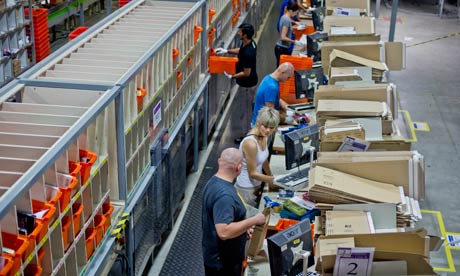
Amazon equals Walmart in the use of monitoring technologies to track the minute-by-minute movements and performance of employees and in settings that go beyond the assembly line to include their movement between loading and unloading docks, between packing and unpacking stations, and to and from the miles of shelving at what Amazon calls its “fulfillment centers”—gigantic warehouses where goods ordered by Amazon’s online customers are sent by manufacturers and wholesalers, there to be shelved, packaged, and sent out again to the Amazon customer.


http://bbpbooks.teachingforchange.org/files/teachingforchange/amazonwarehouse.jpg
Amazon’s shop-floor processes are an extreme variant of Taylorism that Frederick Winslow Taylor himself, a near century after his death, would have no trouble recognizing. With this twenty-first-century Taylorism, management experts, scientific managers, take the basic workplace tasks at Amazon, such as the movement, shelving, and packaging of goods, and break down these tasks into their subtasks, usually measured in seconds; then rely on time and motion studies to find the fastest way to perform each subtask; and then reassemble the subtasks and make this “one best way” the process that employees must follow.

...

In December 2009 Mark Onetto, chief of operations and customer relations at Amazon and a close collaborator of Bezos, gave an hourlong lecture on the Amazon Way to master’s of business administration students at the University of Virginia’s Darden School of Business. Onetto is a disconcerting figure, because once he starts talking, style and substance are in sharp contrast. He is French born, and he still speaks with the rather faded insouciance of Maurice Chevalier and “Gay Paree,” and he makes much of this in his lecture. But there was nothing gay (in the traditional sense) or insouciant about the Amazon workplace that Onetto described for UVA’s MBA candidates.

Like most such corporate mission statements, Onetto’s uses a coded language that hides the harshness of his underlying message, which needs translation along with a hefty reality check. As with Walmart so at Amazon, there is a quasi-religious cult of the customer as an object of “trust” and “care”; Amazon “cares about the customer,” and “everything is driven” for him or her. Early in the lecture, Onetto quotes Bezos himself as saying, “I am not selling stuff. I am facilitating for my customers to buy what they need.”

...

Whereas some Amazon employees are in constant motion across the floors of its enormous centers—the biggest, in Arizona, is the size of twenty-eight football fields—others work on assembly lines packing goods for shipping. An anonymous German student who worked as a temporary packer at Amazon’s depot in Augsburg, southern Germany, has given a revealing account of work on the line at Amazon. Her account appeared in the daily Frankfurter Allgemeine Zeitung, the stern upholder of German financial orthodoxy and not a publication usually given to accounts of workplace abuse by large and powerful corporations. There were six packing lines at Amazon’s Augsburg center, each with two conveyor belts feeding tables where the packers stood and did the packing. The first conveyor belt fed the table with goods stored in boxes, and the second carried the goods away in sealed packages ready for distribution by UPS, FedEx, and their German counterparts.


Staff at Amazon's Marston Gate warehouse.
Image Source:  Sarah Lee, The Guardian
Machines measured whether the packers were meeting their targets for output per hour and whether the finished packages met their targets for weight and so had been packed “the one best way.” But alongside these digital controls there was a team of Taylor’s “functional foremen,” overseers in the full nineteenth-century sense of the term, watching the employees every second to ensure that there was no “time theft,” in the language of Walmart. On the packing lines there were six such foremen, one known in Amazonspeak as a “coworker” and above him five “leads,” whose collective task was to make sure that the line kept moving. Workers would be reprimanded for speaking to one another or for pausing to catch their breath (Verschnaufpause) after an especially tough packing job.

...

A significant portion of the article has been reposted here.  There's more.  You can read the entire article by clicking here.

Note:  It is not hard to find other articles critical of worker conditions at Amazon.com.  The book, Mindless, written by Simon Head and from which this is excerpted, focuses at least in part on abuses such as these.  You can read a short but excellent review of that book, by clicking here.  A quote from the review:  [Head] argues that ... computerized management programs that Amazon and other large organizations use to measure everything that happens in factories, warehouses and depots—are turning workers into “digital chain gang” members who work harder and earn less. Once limited to tracking blue-collar productivity, CBSs now engulf much of the white-collar world, where they control the complex work of physicians, teachers and others in the professional and administrative middle class.

-Submitted by Gareth

Social inequity vs. the environment is a false choice

It's time we stop pretending that inequality and environmental decline are two separate problems 

From Salon.com, March 16, 2014
By Annie Leonard, originally published in Earth Island Journal


Note:  Annie Leonard is an American proponent of sustainability and critic of excessive consumerism. She is most known for her animated film The Story of Stuff about the life-cycle of material goods.

Note 2:  Leonard makes reference to Wilkinson and Pickett.  If you  haven't seen the 17 minute TED talk by Richard Wilkinson called:  "How economic inequality harms societies", I highly recommend it.  You can find it by clicking here.

In this article, Leonard proposes solutions to the challenges of addressing both economic inequality and environmental decline.  While it is a U.S.-based article, it has application to us in Canada as well.

story of solutions annie leonard
Image Source:  Treehugger.com


Excerpts from the article:

Excerpt 1:  On the one hand, inequality is a huge problem, with many people prevented from accessing the resources they need for dignified lives. Inequality is inherently unjust, and is the root of an array of environmental, health, and social ills. In Spirit Level: Why More Equal Societies Almost Always Do Better, public health scientists Richard Wilkinson and Kate Pickett show that high levels of inequality correlate with a stunning array of ills that reduce quality of life for all of society. 

Excerpt 2:  On the other hand, it’s undeniable that worldwide we’re using too many resources. We have only one planet, but globally humanity is using raw materials and generating waste at a rate that would take 1.5 Earths to sustain.

Excerpt 3:  I don’t pretend to have all the answers. But I do have some ideas of steps to get started.

Click here to read the entire article, including her ideas for "getting started".

- Submitted by Gareth
 

Saturday, 22 February 2014

Sign, sign, everywhere a sign

Religious groups join campaign to raise welfare rates

Posted: 02/22/2014Winnipeg Free Press

Prepare to see an economic -- and spiritual -- sign of the times when you drive by a house of worship over the next few weeks.
Some of the city's churches, mosques, and temples and gurdwaras plan to display the same message on their outdoor signs: Love your neighbour as yourself -- raise welfare rates. "God calls us to love your neighbour," says Ken DeLisle, minister at Fort Garry United Church, which sported that message on its sign for most of February.


Minister Ken DeLisle and Dianne Cooper, chairwoman of the leadership team, at Fort Garry United Church.
"If you have two coats, you give one away."
That same message of neighbourliness will also be posted at the outdoor sign of the Singh Sabha Sikh Gurdwarda on Sturgeon Road, says president Jagpal Johal.
Although this current campaign is directed at the specific issue of raising Employment and Income Assistance rates, people of faith have long advocated for justice and compassion for the less fortunate, says a member of Make Poverty History Manitoba, the organization running the sign campaign.

To read the entire Free Press article, click here.

And this is Augustine's contribution to the advocacy.


- Submitted by Nancy R.

Friday, 7 February 2014

Unionizing Bangladesh garment factory workers face intimidation, violence: Report

Garment factory workers in Bangladesh who try to start trade unions are being intimidated and threatened with murder to stop their efforts to organize, a human rights watchdog says.
 - submitted by Gareth

Thursday, 26 December 2013

West Broadway Community Ministries in Free Press

Today's Winnipeg Free Press has two articles featuring West Broadway Community Ministries.  


'No room at the inn in Manitoba' for needy

Christmas Eve trek stresses need for affordable housing
Winnipeg Free Press, December 26, 2013, pages A8, A9

Photo by John Woods, Winnipeg Free Press

"There's no place to go for the Holy Child. Is there no room in Winnipeg?"

So asked 21 members of three West Broadway-area churches who united to pound the pavement on Christmas Eve, knocking on doors on Langside Street in pursuit of affordable housing for Jesus.
In a stunt found more commonly in Mexico, the group performed a version of La Posada, which translates to "the inn." It tells the story of Mary's and Joseph's search for an inn where baby Jesus would be born -- but with a twist.

Community minister Lynda Trono of West Broadway's Community Ministry organized the roaming play and wrote its script, which talked about the lack of affordable housing for those in need in Winnipeg.

"It's a symbolic door-knocking that has to do with there being no room at the inn and right now there's no room at the inn in Manitoba," Trono said.

Trono wants to raise awareness about the meagre amount of money given to Manitobans living on social assistance and trying to afford rent.


IMAGE COMPARISON:  Today's Free Press print copy followed the above story with a report on the crowds that typically line up for Boxing Day specials.  The accompanying photo is an interesting contrast to the image of the West Broadway action above:

Sisters Cetina (from left), Nikketa, and Savana Campbell started waiting at 2 a.m. Thursday to be the first in line for Boxing Day deals on a couple of car starters and an iPod at Advance Electronics in Winnipeg. The sisters waited in their car between 2 and 5 a.m., then braved -21 C temperatures outside until 6 a.m., when the store allowed people inside to wait for the final hour until opening. This is the sisters' third year waiting outside for Boxing Day deals.
Photo source: David Lipnowski, Free Press Archives

Community feels the love

Yule lunch brings fellowship to multi-faith people in need
Winnipeg Free Press, Dec. 26, 2013, page B2

People of all faiths packed into the West Broadway Community Ministry Wednesday afternoon to enjoy a Christmas lunch and each other's company.

Roughly 100 people attended the ministry's annual Christmas lunch put on by volunteers from the Shaarey Zedek Synagogue and the ministry.
Volunteer Larry Flynn helps serve during the Christmas lunch at the West Broadway Community Ministry.                   
(Photo source: Winnipeg Free Press)
The lunch of a chicken pot pie, potato salad and coleslaw began with the lighting of a multi-faith candle.

Volunteers and participants alike said the lunch is all about bringing the community together.
"I think it's so important during this season to be able to feel the love of a community," said Riva McWilliam, a longtime volunteer at the Christmas lunch.

McWilliam and her husband have been helping out with the annual meal for eight years, and it's become a Christmas tradition for them.

They do not celebrate Christmas, so they think it's a perfect opportunity to give back to people in need.

You can read the whole article by clicking here.

- Submitted by Gareth

Friday, 20 December 2013

Open Letter to Winnipeg Re: NEECHI COMMONS

December 13, 2013

Dear friends,
Open Letter to Winnipeg Re: NEECHI COMMONS

This letter is being circulated by the Canadian Worker Co-operative Federation on behalf of the signatories listed below.  These individuals are active in a cross section of co-operative and community economic development organizations as well as in universities.

The letter is intended to let you know about a remarkable sister Co-operative that is blazing a trail in empowerment for its members and social justice in the community. A Co-op doing such principled work that it elevates the name of co-operative enterprise and by reflection enhances all of our reputations. We are talking about Neechi Foods Co-operative in Winnipeg (865 Main Street, at Euclid).  This Co-op needs your patronage and support.

Louise Champagne, the president of the Co-op and long-time leader of the enterprise, shepherding it through more than 23 years of operations and meeting all challenges, recently accepted the 2013 Excellence in Aboriginal Business Leadership Award from the Asper School of Business, University of Manitoba, on behalf of the Co-op. In her acceptance speech Louise made the following comments:

“Neechi Foods Co-op Ltd. is a worker cooperative. This is a form of economic democracy that encourages staff to develop a sense of business ownership. Neechi means “friend”, “sister” or “brother” in Cree and Ojibwa.

On March 19 this year (2013) we held the Grand Opening of Neechi Commons, our beautiful, 30,000 square foot, community business complex at 865 Main Street, for which we received a Green Globes award for high environmental standards. Previously we operated a nearby, small corner grocery and Aboriginal specialty store for 23 years.

In Neechi’s early days we drew up a list of community economic development principles:

       creation of goods & services that are used locally
       purchases of locally produced goods
       local reinvestment of surpluses (profits)
       employment and training of local people
       community-oriented business ownership
       community health and
       human dignity

We were the first grocery operation in Manitoba to not sell cigarettes – ahead of the pharmacies! At our old store we have always had a children’s fruit basket, subsidized by the staff, where the previous owner sold cigarettes, war toys and Barbie dolls. We also have run various diabetes prevention programs and played a key role in neighbourhood efforts to push back street prostitution and other gang activities that became rampant in the mid 1990s.

All along we have understood that economic healing is needed to sustain personal and social healing. This is the context in which Neechi Commons was born. We have taken what we did at our old store to a much higher level, including a strong focus on regionally harvested and processed foods, a lovely art store and gallery, a restaurant and catering service backed up by an impressive commercial kitchen, a well equipped bakery, and a neighbourhood supermarket with a fruit and vegetable courtyard, freshwater fish and full meat service.”

Neechi Commons needs your help to achieve its goals. It hopes to become the cornerstone for the revitalization of commerce in a Winnipeg neighbourhood that has faced long-term economic hardship. The Co-op has created over 50 new employment opportunities for aboriginal youth and other neighbourhood residents.

Neechi Co-op has not chosen an easy path focused only on commercial viability. It has chosen to blaze a trail to be a transformative venture in the same spirit as other Co-operative pioneers. Its success will not only be a beacon of light in its local neighbourhood but also a shining example of the inherent power of the Co-operative form of enterprise to change lives for the better.

The most obvious and simple way that you can support Neechi is by purchasing products at the Commons.  Another way that you can help is by signing up for Neechi’s weekly e-mail promotion and updates, at neechifoods@shaw.ca.

Your support can help to ensure the success of this Co-operative enterprise. In the words of Louise Champagne:  “We will remain heavily focused on achieving the commercial profitability needed for long-term business and community success. Neechi Commons symbolizes how Aboriginal People can regain control of land and economic decision-making within a modern community context.”

Sincerely yours,

• Cindy Coker, Executive Director, SEED Winnipeg
• Hazel Corcoran, CWCF Executive Director, Calgary
• David Kerr, Co-op Consultant, Winnipeg
• Richard LeMoing, Director, Manitoba Co-operative Association, Minnedosa, MB
• Marty Donkervoort, Social Enterprise Consultant and Instructor, University of Winnipeg, Winnipeg
• Shaun Loney, Executive Director, BUILD (Building Urban Industries for Local Development)
• Greg O’Neill, Co-operative Developer, Calgary
• Dr. Claudia Sanchez-Bajo, Chair of Co-operative Enterprises, University of Winnipeg
• Lucas Stewart, General Manager, Manitoba Green Retrofit Inc., Winnipeg
• Dr. Wanda Wuttunee, Professor, Native Studies & Director, Aboriginal Business Education Partners, University of Manitoba 

PS To learn more about Neechi Commons, see: www.neechi.ca.   The link to this letter on the CWCF web site is : http://canadianworker.coop/news/neechi .

- Submitted by Bev

Joint Review Panel recommendation to support Northern Gateway pipeline ignores strong opposition of First Nations and citizens

Photo credit: Marco Guada via flickr.
 
Please send a message of support to the 130 First Nations that stand against the Enbridge Northern Gateway Pipeline.  The Joint Review Panel has recommended approval of the Northern Gateway pipeline.  But this is far from over.  You can take action now to support First Nations, protect our coast, and move toward a carbon free future.

Let them know you stand with them in solidarity as part of an unbroken wall of opposition.

This message will also be sent to the Prime Minister and his Cabinet who now have the choice to side with Canadians or with Enbridge. The decision is in their hands. To move forward, they need First Nations cooperation and support from British Columbians, and they have neither.

The David Suzuki Foundation signed the Solidarity Accord for the Save the Fraser Declaration, agreeing with the Yinka Dene Alliance that we need to uphold indigenous laws and protect the health of British Columbia’s Fraser River watershed, including its headwaters.

And the vast majority agree. At community hearings across BC, the Joint Review Panel heard from 1,159 people who spoke against the pipeline. Only two spoke for it.
Remember, this isn’t the end of the discussion. Make your voice heard now.

You can link to the David Suzuki Foundation website to send a letter.

-submitted by Karla

Homeless Jesus on Park Bench - artist's website

http://storage.canoe.ca/v1/dynamic_resize/sws_path/suns-prod-images/1297499302929_ORIGINAL.jpg?quality=80&size=420x
photo source:  Toronto Sun

Bob located the website of Timothy Schmalz, the artist who created the sculpture of the homeless Jesus lying on a bench (see previous posts:  Dec 8, 2013).  You will find information about the artist, and a youtube video of the process of creating the homeless Jesus.

You can find Schmalz's website here.

-submitted by Bob

USAS Year-End Report: ‘Tis the Season of Solidarity

 
On the eve of the six month anniversary of the Rana Plaza collapse, which claimed the lives of 1,134 Bangladeshi garment workers, we launched a new movement on college campuses across the country to demand an end to deathtrap factories. In the last eight years alone, over 1,800 Bangladeshi garment workers have died in building collapses and factory fires while earning just $37 per month on the job. On our campuses we are calling on our universities to require brands producing college-logo apparel to sign the Accord on Fire and Building Safety in Bangladesh, a legally-binding contract — a Contract to End Deathtraps — between unions and brands that will transform the Bangladesh garment industry from deathtraps to safe workplaces — if enough brands sign it. Already, we’ve won impressive victories, with Temple, Duke, UPenn and NYU announcing that they will require their licensees to sign the Accord, and we won’t stop until every university in the country does the same! In response to this pressure, Adidas, Knights Apparel, Top of the World, and Fruit of the Loom just recently signed the Accord!


Campaign for a Contract to End Deathtraps

Campus Worker Justice


On dozens of campuses across the country, USAS locals are campaigning alongside campus workers and their unions to halt corporate outsourcing, raise wages, and negotiate fair contracts. Students in Boston, LA and DC are standing with adjuncts in their fight for a union voice. All across Tennessee, USASers are supporting the United Campus Workers in their fight for a living wage, and recently won a dollar raise for the lowest-paid campus workers in the UT system. In California, USASers walked the picket lines with AFSCME 3299 and UAW 2865 in the largest strike ever in the University of California system. At the University of Texas at Austin, USAS and the Texas State Employees Union successfully halted plans to outsource food service workers, and continue to campaign against the administration’s efforts to privatize other parts of the campus.

You can find the USAS website here.

-Submitted by Kathleen

Thursday, 12 December 2013

Protect Costa Rica's rainforests from Infinito Gold

This is from the website:  sumofus.org
 Infinito Gold, a Canadian mining company, just slapped Costa Rica with a $1 billion lawsuit because the nation decided to protect its rainforests rather than host an open-pit gold mine.
Costa Rica’s rainforest is lauded as one of the most beautiful in the world, and is home to many endangered species, including the green macaw. Officials considered approving the gold mine, but the use of toxic chemicals such as cyanide -- which often leaks into and pollutes nearby lakes and rivers -- was far too great a risk to allow the project to move forward.

Image Source:  sumofus.org

A subsidiary of Infinito Gold has announced that a massive lawsuit against Costa Rica is “imminent”, so we need to act now. If thousands of us stand together against this toxic mine, we can show Infinito that Costa Rica and other countries that are defending their natural resources will not be silently bullied by corporate power.

Tell Infinito Gold to drop its $1 billion lawsuit against Costa Rica.

Open-pit gold mining in Costa Rica would destroy 190 hectares of pristine forest. The rainforest houses 5% of the world’s species and has seen tremendous growth in the ecotourism industry. Over 75% of Costa Ricans oppose mining and have decided that they cannot take the risk to move forward with gold-mining in the country.

And Costa Rica is not the first to be sued by Infinito Gold. In 2001, Infinito Gold locked Venezuela into a ten-year legal battle over a rejected mine. Fortunately, Infinito lost. We can make sure Infinito Gold loses again by standing up to its greedy tactics and shameful behavior. Corporate profits cannot take precedence over the health of the people and the environment.

Stand up for Costa Rica’s rainforests -- tell Infinito Gold to drop the $1 billion lawsuit now.


You can sign a petition to pressure Calgary-based Infinito Gold to drop its lawsuit by going to the sumofus website.

**********
More information:
All That Glitters. Corporate Knights, 3 Oct 2013.
Calgary-based mining company suing Costa Rica for more that $1 Billion. Global News, 4 Oct 2013.

- Submitted by Nancy P.