Showing posts with label Idle No More. Show all posts
Showing posts with label Idle No More. Show all posts
Monday, 2 November 2015
Amazing Book List
Go to this link to find an amazing book list focused on "Being an Ally and Understanding Colonialism", compiled by Tessa Blaikie Whitecloud of 1JustCity.

Sunday, 28 September 2014
Declarations of Canadians for a New Partnership
Shelagh Rogers was in Winnipeg yesterday evening (Sept 27), joining Wab Kinew in hosting the Burt Award for First Nations, Metis and Inuit Literature. I had the privilege of being there representing the Canadian Commission for UNESCO. It was very obvious during the course of the evening, that Shelagh is powerfully committed to being in partnership with First Peoples. Here is a letter from Shelagh that Karla has forwarded, inviting us all to sign the online Declaration of Canadians for a New Partnership. Here is Shelagh's letter. Please consider signing the declaration. The link is at the bottom of the post.
----------------------
Dear Friend,
On
Thursday, Canadians for a New Partnership was launched. Its purpose is
to advance the public's knowledge and understanding of the histories and
cultures of First Peoples,
their contribution to Canada and the current issues affecting
reconciliation and improved relationships between First Peoples and
other Canadians by delivering a national lecture series, operating a
speaker’s bureau, maintaining a website, and providing educational
materials and resources. We will also do all things that are incidental
or conducive to the attainment of these objectives.
I
am a member of the board, which includes two former Prime Ministers,
two former Assembly of First Nations Chiefs, Sheila Fraser, the Metis
leader Tony Belcourt, Mary Simon,
Sheila Watt-Cloutier, Chelsea Vowel and Stephen Kakfwi, former NWT
Premier and residential school Survivor, among others.
I'm writing to ask if you will sign our on-line Declaration and help spread the word. Many signatures will make a real impact.
love,
Thursday, 27 March 2014
WALKING WITH OUR SISTERS - A Commemorative Art Installation

Submitted by Karla W.
After some time and many needle pokes our contribution to the project was complete and was submitted along with the over 1000 others who participated.
 |
| photo by Karla W. |
Now on exhibit at the
URBAN SHAMAN GALLERY
(March 7 - April 12, 2014)
Thursday, 20 March 2014
A Canadian genocide?
From United Church Observer
By Larry Krotz
 |
| Image Source: Edward S. Curtis/Library and Archives Canada/PA-039476 |
There is something inherently perverse about the Canadian Museum for Human Rights, the as-yet-unfinished landmark rising from the plain between a parking lot and a baseball stadium at Winnipeg’s Forks. When you get right down to it, this $351-million dream of the late media mogul Izzy Asper is being built to document evil.
Of course, it will also document survival against horrible odds and endurance in the face of atrocities that human beings inflict on one another. If you and your people have come through the worst of horrors, then that in itself is cause for celebration. But getting to be included in the museum’s litany of narratives has become a kind of race to the bottom: “The things that happened to my people are just as bad — if not worse — than those that happened to yours.” Or, as various groups already included in the museum have complained to its developers since almost day one, “The story you are proposing to tell about my people is not nearly so bad as it should be.”
The museum, which opens in September and is one of only two national museums located outside Ottawa-Hull, has been taking shape for more than a decade. In that time, disputes have almost constantly overshadowed what its promoters would prefer to highlight: a glass atrium “cloud” symbolizing the wings of a dove; spiral staircases leading up to a light-filled 100-metre-tall Tower of Hope; and a “mountain” made of 450-million-year-old Tyndall limestone from Manitoba. Possibly, museum of something as touchy as human rights should expect controversy. It is a museum of grievances, and it is very hard to make the aggrieved happy.
The Ukrainian community, for example, lamented that exhibits on the Holodomor (the 1932-33 starvation engineered by Soviet Union leader Joseph Stalin) were going to be too close to the washrooms; Palestinians objected to being left out entirely; even Jews — whom Asper envisioned as central to the museum — were reportedly upset that the founding of the state of Israel was not going to be commemorated.
But the nascent museum’s most heated controversy is the growing insistence that exhibits depicting the story of First Nations peoples carry the word “genocide” in their titles. So far, the museum has resisted doing that.
The Canadian government currently recognizes five genocides: the Holocaust, the Holodomor, the Armenian genocide in 1915, the Rwandan atrocities in 1994 and the Bosnian ethnic cleansing from 1992 to 1995. First Nations activists aim to add one more to the list. For them, the museum is a testing ground.
- Submitted by Kathleen
Tuesday, 4 February 2014

National Congress of American Indians: We do not call ourselves R--skins
In time for the Superbowl, the National Congress of American Indians released a PSA calling for the renaming of the Washington football team. This article is from Salon.com. You can see the 2 minute PSA by clicking here.

As football fans gear up for the Super Bowl, the National Congress of American Indians has issued a PSA to remind them that the Washington Redskins is still a team name, and that, yes, it is still offensive.
In October, President Obama said if he owned the football team, he would “think about changing” the name, which is a slur for Native Americans — an opinion that team owner Dan Snyder does not share.
The PSA lists several things that Native Americans call themselves, like “proud,” “underserved,” and “forgotten.” They do not, however, call themselves R--skins.
Other football teams that have Native Americans as mascots include the Kansas City Chiefs, the Atlanta Braves and the Cleveland Indians.
Question: Do we give any thought to other names like "Edmonton Eskimos", when Inuit people don't any longer use the European-generated name for themselves (and nor do most other contemporary Canadians)? While it's clearly not as loaded as "R--skins", "Eskimos" is out-of-date, and harkens back to a colonial period we're working to get past.
You can find good information about issues such as these at the facebook site: Decolonizing Forum-Manitoba
- Submitted by Gareth
Pipeline rupture report raises questions about TransCanada inspections
2011 report criticized TransCanada’s ‘inadequate’ inspections
A CBC News investigation has unearthed a critical report that the federal regulator effectively buried for several years about a rupture on a trouble-prone TransCanada natural gas pipeline.
On July 20, 2009, the Peace River Mainline in northern Alberta exploded, sending 50-metre-tall flames into the air and razing a two-hectare wooded area.
 |
| On July 20, 2009, the Peace River Mainline in northern Alberta exploded, sending 50-metre-tall flames into the air and razing a two-hectare wooded area. (Courtesy of Dene Tha' First Nation) |
Few people ever learned of the rupture — one of the largest in the past decade — other than the Dene Tha’ First Nation, whose traditional territory it happened on.
In an early 2011 draft report about the incident, the National Energy Board criticized TransCanada, the operator of the line owned by its subsidiary NOVA Gas Transmission, for “inadequate” field inspections and “ineffective” management.
Final reports are typically published by the investigative bodies, either the NEB or the Transportation Safety Board, but this report wasn’t released until this January when the CBC obtained it through an access-to-information request.
The NEB said the delay was caused by an “administrative error” when an employee left without transferring the file over.
In a written statement, TransCanada said there's a combination of construction, coating and soil factors that have required an "active pipe integrity program" on this pipeline. The company said it instituted new technologies and new approaches after the rupture that have since prevented a reoccurrence.
You can read the entire article by clicking here.
- Submitted by Gareth
Wednesday, 15 January 2014
Silence of the Labs, Fifth Estate

Cori drew a Fifth Estate documentary to our attention at the last meeting called Silence of the Labs. It focuses on the underfunding and even suppression of science and scientific evidence by our current federal government. As the result of her having raised this concern in the Just Living group, a sub-group (so far made up of Cori, Michele, Gareth, Kathleen) have agreed to find out more about the impact of these policies are having on the environment, and so much more. If others, who could not attend the last meeting, are interested in joining this group inquiring into this issue, please let Cori know.
The documentary can by seen by clicking here.
Manitoba Indigenous Writers' Festival
The Festival runs from Thursday, Jan. 16 at 7 p.m. to Saturday, Jan. 18.
The Thursday, Friday, and Saturday evening portions of the Festival are at Neechi Commons, 865 Main St. from 7 - 10 p.m.
- Writers confirmed and appearing at Thursday night opening night show so far:
Ko'ona Cochrane (drum song)
Niigaanwewidam James Sinclair (host)
Althea Guiboche
Michael Hutchinson
Warren Cariou
Marie Annharte
Duncan Mercredi
Katherena Vermette
Also, Renate Eigenbrod speaking and launching a new Indigenous writers anthology (which will be for sale)!
- for more info, please go to Facebook: https://www.facebook.com/events/668686833183270/ or (www.facebook.com/mbiwf)

Saturday, 9 November 2013
Grassroutes, UW
This event Tuesday evening has been recommended by a number of Just Living folks, including Karla, Kathleen and Mike.
Extractive
Industries, Indigenous Development, and the Environment: A
Panel Discussion

Tuesday, November 12, 7-9 pm -- The University of Winnipeg, (Riddell Hall)
Speakers: Wab Kinew, Richard Atleo, Darren Courchene, and more, moderated by Julie Pelletier. More speakers TBA.
In April 2013, an article in the Guardian claimed that “Indigenous rights are the best defence against Canada’s resource rush” and that “First Nations people – and the decision of Canadians to stand alongside them – will determine the fate of the planet.” This “natural marriage” between environmental activism and movements for Indigenous rights is not new. But is it useful? Or does it simply recycle old myths of the Noble Savage? What is the relationship between Indigenous development and extractive industries in Canada? Where does environmental activism fit into the picture?
For more information, for speaker profiles, and for more information about the Grass Routes festival visit www.grassroutes.ca
Tuesday, 22 October 2013
New Brunswick fracking protests are the frontline of a democratic fight
Images of burning cars and narratives about Canadian natives breaking
the law obscure the real story about the Mi'kmaq people's opposition to
shale gas exploration
Excerpt 1: The image of burning police cars played endlessly on the evening
news. Television and talk radio blared out reports of "clashes" between
police and indigenous protestors. Last Thursday in New Brunswick near
the Elsipogtog First Nation, we were told the government had enforced an
injunction against a blockade of a US shale gas company. There was
nothing about the roots of a conflict years in the making. An appeal to
the stereotype of indigenous violence was enough: once again, the
natives were breaking the law; the police had to be sent in. Catching
the headlines, Canadian could shake their heads and turn away their
gaze.
But smoke and flames from police cars can only hide the truth for so long. The exact chronology is not yet settled, but this much is clear: on Thursday morning someone in government sanctioned the Canadian police to invade a peaceful protest site like an army. In a dawn raid, snipers crawled through the forest, putting children and elders in their cross-hairs. Police carried assault rifles and snarling dogs, and sprayed tear gas and shot rubber-type bullets. The result was predictable: shocked and enraged people, a day ending in chaos.
There is only one reason the police were unleashed. Not because of the New Brunswick Premier's claims about the dangers of an "armed encampment"; protestors had been unswervingly non-violent for months. Ever since 2010, when New Brunswick handed out 1.4 million hectares of land – one-seventh of the province – to shale gas exploration, opposition had been mounting. Petitions, town hall meetings, marches on legislature had slowly transformed to civil disobedience, and in October, to the blockade of equipment that Texan SNW Resources was using for seismic testing. The company was losing $60,000 daily, and the non-violent defiance had put a wrinkle in the Premier's plans for a resource boom. The blockade had to go.
Excerpt 2: "It is our responsibility to protect Mother Earth, to protect the land for non-natives too," says Susan Levi-Peters, the former Chief of Elsipogtog. "My people are speaking up for everyone." Others have heard. Since the beginning of the summer, Levi-Peters has seen indigenous Maliseet, Acadians and anglophone New Brunswickers drawn to this new epicentre of resistance on her community's traditional lands. "People care about the water. People care about the environment. This isn't just a native issue."
But let's be clear about one way this is a "native issue": the rush underway for dirtier and more extreme fossil fuels and minerals, in New Brunswick and across Canada, is just the latest stage of colonial pillage. It's a badly-kept secret that Canada's oil, gas and mineral wealth, the key to Prime Minister Stephen Harper's reckless resource obsession, are mostly on Indigenous lands. And if industry is to have them, the country's national myths must be summoned. In last week's Speech from the Throne, Harper praised the "courage and audacity" of the country's "pioneers," who "forged an independent country where non would have otherwise existed." A day later, the raid on Elsipogtog was effectively a footnote.
Excerpt 3: Freed of the distractions, we will be left with a single question. Do we obey provincial dictates that grant a company license to pollute the water? Or the laws of Indigenous peoples, of the Supreme Court, and of our conscience, calling us to protect it? The answer will tell us everything about the kind of country we will have.
To read the entire article, click here.
Excerpts of this Guardian article have been published here. To read the entire article, click here.
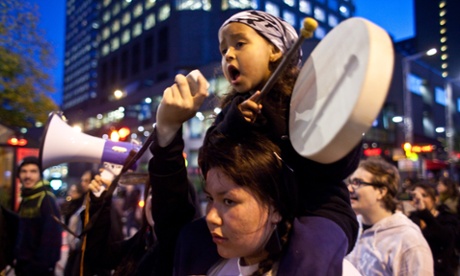 |
| A girl plays the drums as she sings a traditional First Nations song during an anti shale gas demonstration in Montreal in support of the Mikmaq people of Elsipogtog First Nations in New Brunswick. Photograph: Oscar Aguirre/Demotix/Corbis |
But smoke and flames from police cars can only hide the truth for so long. The exact chronology is not yet settled, but this much is clear: on Thursday morning someone in government sanctioned the Canadian police to invade a peaceful protest site like an army. In a dawn raid, snipers crawled through the forest, putting children and elders in their cross-hairs. Police carried assault rifles and snarling dogs, and sprayed tear gas and shot rubber-type bullets. The result was predictable: shocked and enraged people, a day ending in chaos.
There is only one reason the police were unleashed. Not because of the New Brunswick Premier's claims about the dangers of an "armed encampment"; protestors had been unswervingly non-violent for months. Ever since 2010, when New Brunswick handed out 1.4 million hectares of land – one-seventh of the province – to shale gas exploration, opposition had been mounting. Petitions, town hall meetings, marches on legislature had slowly transformed to civil disobedience, and in October, to the blockade of equipment that Texan SNW Resources was using for seismic testing. The company was losing $60,000 daily, and the non-violent defiance had put a wrinkle in the Premier's plans for a resource boom. The blockade had to go.
Excerpt 2: "It is our responsibility to protect Mother Earth, to protect the land for non-natives too," says Susan Levi-Peters, the former Chief of Elsipogtog. "My people are speaking up for everyone." Others have heard. Since the beginning of the summer, Levi-Peters has seen indigenous Maliseet, Acadians and anglophone New Brunswickers drawn to this new epicentre of resistance on her community's traditional lands. "People care about the water. People care about the environment. This isn't just a native issue."
But let's be clear about one way this is a "native issue": the rush underway for dirtier and more extreme fossil fuels and minerals, in New Brunswick and across Canada, is just the latest stage of colonial pillage. It's a badly-kept secret that Canada's oil, gas and mineral wealth, the key to Prime Minister Stephen Harper's reckless resource obsession, are mostly on Indigenous lands. And if industry is to have them, the country's national myths must be summoned. In last week's Speech from the Throne, Harper praised the "courage and audacity" of the country's "pioneers," who "forged an independent country where non would have otherwise existed." A day later, the raid on Elsipogtog was effectively a footnote.
Excerpt 3: Freed of the distractions, we will be left with a single question. Do we obey provincial dictates that grant a company license to pollute the water? Or the laws of Indigenous peoples, of the Supreme Court, and of our conscience, calling us to protect it? The answer will tell us everything about the kind of country we will have.
To read the entire article, click here.
-submitted by Gareth
Tuesday, 30 April 2013
Idle No More and Respecting Mother Earth in Hollister, California
It's encouraging that Idle No More continues to inspire care for the earth. Here's an example of how there are communities beyond Canada in solidarity with INM. This article is from the Santa Cruz Indymedia:
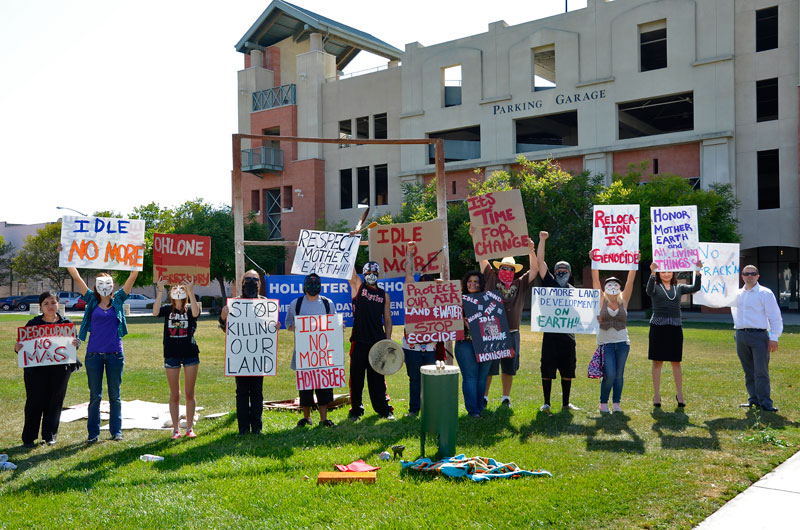
On April 27 community members in Hollister, California (SE of San Francisco), gathered in solidarity with the Idle No More movement and First Nations people. Organizers of the gathering asked supporters to, "join the Communities of Hollister as we gather with songs and prayers in solidarity with our Northern Brothers and Sisters and all Indigenous People."
 | ||
| Photo Source: Santa Cruz Indymedia |
"People think that she's going to be there forever, but she's not, if we don't protect her today and tomorrow and in the future we won't have a future. Our future generations won't have Earth, or water, or air, or land to grow anything...if we look everyday we see how polluted the air is...we cant even drink water in the rivers."
She emphasized that, "all nations are in this battle together."
The gathering was held at the busy corner of 4th and San Benito Streets in downtown Hollister, which at a population of just over 35,000, is the largest city in the very rural San Benito County.
Individuals held signs with statements such as "No XL Pipeline," "Earth is Everyone," "Ohlone Territory," "Honk for Indians," "Desocupada No Mas," and "Idle No Mas."
Continue reading here.
- Submitted by Gareth
Thursday, 28 March 2013
Primer on Treaties coming Saturday
James Wilson, the commissioner of Treaty Relations Commission of Manitoba (a "neutral body mandated to encourage discussion, facilitate public understanding, and enhance mutual respect between all peoples in Manitoba") has written a column in today's (March 28) Winnipeg Free Press (Page A14), in which he is alerting WFP readers to look for Saturday's (March 30) special edition called Our Past - Our Future.
Wilson writes: "Over the section's many pages, you will experience stories shared by individuals and communities who have battled rampant racism and, together, made huge strides to overcome their racially charged histories.
You will learn a lot more about current issues such as urban reserves and the potential for the Kapyong land to be transformed into a thriving area for economic development, if that decision moves ahead. You will also hear about the successes in Saskatchewan, which is 20 years ahead of Manitoba when it comes to building these kinds of business partnerships.
We also invite you to learn more about Idle No More and the growing frustration that gave rise to this movement and to take a look back in time for a primer on the historical treaties, signed over the last 100 years, and how they are celebrated on Treaty Day each summer."
You can read Wilson's entire column here.
 |
| Stephanie Woodhouse shows $5 bills she collected on behalf of herself and children at annual treaty payment at The Forks last June. (Source: Winnipeg Free Press) |
Wilson writes: "Over the section's many pages, you will experience stories shared by individuals and communities who have battled rampant racism and, together, made huge strides to overcome their racially charged histories.
You will learn a lot more about current issues such as urban reserves and the potential for the Kapyong land to be transformed into a thriving area for economic development, if that decision moves ahead. You will also hear about the successes in Saskatchewan, which is 20 years ahead of Manitoba when it comes to building these kinds of business partnerships.
We also invite you to learn more about Idle No More and the growing frustration that gave rise to this movement and to take a look back in time for a primer on the historical treaties, signed over the last 100 years, and how they are celebrated on Treaty Day each summer."
You can read Wilson's entire column here.
- Submitted by Gareth N.
Monday, 25 March 2013
IDLE NO MORE, Public Conversation and Round Dancing
On
March 18, a group of about 50 attended a “Public Conversation” about Idle
No More, presented by Fort Garry United Church and St. Paul’s
Anglican. Corie, Karla, Kathleen and Gareth were
among those attending the evening. Adrian Jacobs (Sandy
Saulteaux Spiritual Centre) and Nigaanwewi James Sinclair (Aboriginal Student Centre, U of M) each
spoke for about 30 minutes, followed by a question period. This is a very brief summary of the main points of the evening.

 So, this past Friday, some of us from “Just
Living” attended a Round Dance in centre-court of Polo Park. Wonderful energy, as shoppers and dancers mingled, transforming the spirit of the place.
So, this past Friday, some of us from “Just
Living” attended a Round Dance in centre-court of Polo Park. Wonderful energy, as shoppers and dancers mingled, transforming the spirit of the place.
Adrian Jacobs spoke first,
detailing the various colonial legacies that have made it very difficult for
First Nations to experience justice today. Historically, indigenous peoples have suffered from
·
Colonialism,
with its external locus of control
·
The
Indian Act (see first point)
·
The
breaking of treaties
·
Residential
schools
·
Systemic
racism
·
Poverty
·
Metis
invisibility
 |
| Kathleen, Karla, Corie hearing about Idle No More |
He explained
that most of these issues have been urgent for 150 years, and that attention to
them didn’t begin with Idle No More. Today, the following continue to
contribute to ongoing social inequality
·
Globalization
·
Migration
/ transience
·
Loss
of language and culture
·
Disconnection
to the land
·
Disease
related to poverty (e.g. Type 2 Diabetes, worsened by “colonial” diet of white
flour / sugar / fat)
Nigaan Sinclair spoke extensively about the issue of
treaties, beginning by describing how these treaties were understood to be
between two equitable partners, and therefore reciprocal. He likened these treaties to “making us
family”.
Currently, there
are three main areas of urgency, Neegan explained:
 |
| Nigaan S. with Treaty projected behind |
1. C45
– Omnibus legislation: this removes First Nation territory
through new leasing rules. It also
removes protection of the waters, opening the door to pipelines over rivers,
and a speeded up approval process.
2. Emergency
situations, that require
immediate action. Examples:
housing is terrible in places like Attwapiskat; access to water lacking in
areas like Island Lake and Garden Hill First Nations.
3. What
is our relationship? Is it one of mutual respect? How do we begin to restore the
relationship to be one of equality?
In speaking
about the need for action in these three areas, Neegan elaborated on two main
areas of violation, returning to some of the points made by Adrian.
1. Violation of nationhood, which must be
repaired through a restoration of treaty relationship and dignity
2. Betrayal of the land. Initially, First Nations had agreed to share the land, not lose the land. First
Nations never gave up title to the land, so they may be
understood to still be “investors” in the land … what “dividends” will they be
able to claim?
Neegan spoke of Idle
No More being “over” … that
it’s more important to ensure that the momentum generated by the energy of the
movement not be lost, even if it isn’t called Idle No More. He pointed to Round Dancing in malls as
a peaceful and powerful action in the heart of a consumerist society, and
encouraged us to be allies in non-violent, celebrative actions.

 So, this past Friday, some of us from “Just
Living” attended a Round Dance in centre-court of Polo Park. Wonderful energy, as shoppers and dancers mingled, transforming the spirit of the place.
So, this past Friday, some of us from “Just
Living” attended a Round Dance in centre-court of Polo Park. Wonderful energy, as shoppers and dancers mingled, transforming the spirit of the place.
- Submitted by Gareth N.
Thursday, 7 March 2013
No Longer Idle...now what? Transforming the energy of "IDLE NO MORE" into real change for communities with Wab Kinew
Dynamic speaker, Wab Kinew, exceeded my already high expectations with his hour long presentation sponsored by the University of Winnipeg at the Selkirk Street campus yesterday.
Charting the chronological unfoldling of the grassroots origins of "Idle No More" to the present day lower profile, "less newsworthy" yet significant actions of the movement, Wab demonstrated an unwavering deep devotion to the movement and to teaching others to work towards a timely resolution. Weaving humour into his intelligent and well organized PowerPoint presentation (all the while holding a sacred eagle feather) the time went by very quickly.
Wab shared a small piece on the issue of the residential schools. He told us that the effects from the residential schools have, by some, been likened to the intended goal of the Neutron bomb. This bomb was designed to make all the inhabitants of a place disappear while leaving the land and it's resources intact and untouched. This metaphor served as a stark reminder of the unthinkable human violation that was imposed on First Nations families. One native elder who was present spoke up and said that "they didn't ever really win" and that her mother never gave up remembering..."she died fighting".
Submitted by Karla W.
Key points were:
~"Idle No More", despite support/favour from political parties or other groups needs to remain non-partisan.
~The treaties were created in good faith with the Crown (Governor General) and Federal Government and that is who First Nations leaders want to continue dealing with in matters relating to all treaties.
~The Indian Act should not be abruptly removed (as has been proposed by the Federal Conservatives). A well considered transition to a more inclusive way of living while honouring treaty rights needs to come to pass so as not to inflict further culture shock on recovering generations of First Nations peoples.
~The effect of culture and language loss due to modern forces such as communication technology and media is a roadblock in efforts to heal and reclaim lost culture.
~One proposed solution to find a way out and to begin to heal the multigenerational problems and abuses that have become a consequence of the residential schools was presented. Wab cites teachings from the book, The Power of Habit by Charles Duhigg, as being a tool to break the cycle of the many insidious abuses and high suicide rates of his aboriginal brothers and sisters.
i.e. Cue/routine/reward being the basic cycle of emotional pain. Nothing can be done to prevent a cue from occuring (a trigger which causes the hurt) nor can the need for reward be changed. Only the routine or "habit" can be altered to affect a more positive, life giving individual change in order to create collective change.
Wab shared a small piece on the issue of the residential schools. He told us that the effects from the residential schools have, by some, been likened to the intended goal of the Neutron bomb. This bomb was designed to make all the inhabitants of a place disappear while leaving the land and it's resources intact and untouched. This metaphor served as a stark reminder of the unthinkable human violation that was imposed on First Nations families. One native elder who was present spoke up and said that "they didn't ever really win" and that her mother never gave up remembering..."she died fighting".
In closing, Wab shared his personal Declaration Of Dedication that outlines his commitment to healthy living (physically, emotionally and spiritually) every day in order to be his personal best. He encourages aboriginal youth to value themselves in the same way. He then sang a wonderful song, first in Ojibway then translated to English...happy and loving, infused with some very articulate rap :)
Four members of our Just Living group attended (Cori, Mike, Amanda and Karla). We were all in agreement that the heartfelt presentation was not only informative, but powerful.
I felt privileged and was very thankful I was able to attend.
 |
| Wab sings/raps his message |
Wednesday, 6 March 2013
Idle No More – a Public Conversation
March 18, 7-9 p.m.
Fort Garry United, 800 Point Road, Winnipeg
Speakers: Adrian Jacobs from Sandy Saulteaux Spiritual Centre and Nigaanwewi James Sinclair, Aboriginal Student Centre, University of Manitoba
All are welcome to listen and question and learn about some of the issues involved.
Co-Sponsored by Fort Garry United and St Paul's Anglican Churches.
Submitted by Bob G.
Sunday, 3 March 2013

NO LONGER IDLE ... NOW WHAT? with Wab Kinew
This event is on the Selkirk Avenue University of Wpg. campus. Submitted by Mike M.

Urban and Inner-City Studies
WAB KINEW
Director of Indigenous Inclusion at the University of Winnipeg
“No longer idle…now what? Transforming the energy of “Idle
No More” into real change for communities.

Free Coffee and Lunch Will be Provided
Students and Community Members are Welcome – Please
Plan to Attend!
When: Wednesday, March 6, 2013
Time: 12:00 –
1:00 p.m.
Where: University
of Winnipeg Department of Urban and
Inner-City Studies North End Campus
Lower Level, 527 Selkirk
Avenue.
Saturday, 2 March 2013
RETURNING PARADIGMS
Here's some info on a day-long symposium at the U of M about Idle No More, next Friday. Looks interesting. Submitted by Nancy R.
The University of Manitoba Native Studies Graduate Students' Association invites you to an all-day Idle No More symposium:
RETURNING PARADIGMS
10am - 5pm Friday March 8th. University Centre (UC), 2nd floor Multi-Purpose Room.
- Hourly Featured Presentations with open Q & A.
- Free and public welcome, come for an hour or two or stay for the day, as you please.
- Refreshments provided
#1 10am - 11am INTRODUCTION TO IDLE NO MORE: DECOLONIZATION IN CONTEXT
- Helen Agger (Grad PhD, U of M) & Judy Da Silva (Grassy Narrows FN, Treaty 3)
- Ryan Duplassie (Grad Phd, U of M) & Charles Wagamese (White Dog FN, Treaty 3)
ROUND DANCE 12:15 - 12:45 pm @ outside Migizii Agamik
#3 1:00 pm - 2:00 pm ANISHINAABE WOMEN SPEAK ON TRADITIONAL GOVERNANCE AND THE IMPACTS OF THE INDIAN ACT ON WOMEN IN THE ANISHINAABE NATION AND IN CANADA
- Shavon and Theresa Sinclair (Hollow Water FN, Treaty 5)
- Emily Grafton (Grad PhD, U of M)
- Paul Murphy (Grad PhD, U of M)
- Alon Weinberg (Grad M.A., U of M) & Charles Wagamese (White Dog FN, Treaty 3)
Subscribe to:
Posts (Atom)