Showing posts with label Food Security. Show all posts

Tuesday, 28 July 2015

Churches for Freedom Road


Augustine United Church has joined many other churches in using their signs to call for justice for the Shoal Lake 40 First Nation.  This is part of a larger effort to apply pressure on the federal government to build an all-season access road, so that Shoal Lake's 17 year boiled water advisory can be lifted.  Go to their website for more information.

I'm a little disappointed that the initiative is being called "Churches" for Freedom Road, since I'd heard early on that there was interest from mosques, synagogues and temples to participate in this call for justice.  Not sure what happened to that.  As it stands, it would be unlikely for some of these other faith communities to join up, given the name of the initiative.  


- Submitted by Gareth

Tuesday, 31 March 2015

"Boycott Driscoll's berries!" - Farmworkers


From Treehugger.com
Until their employer agrees to negotiate fairly, farmworkers in Washington state want consumers to avoid all Driscoll's, Häagen-Dazs and Yoplait products that contain berries grown on the notorious Sakuma Brothers farm.
Farm workers in Washington state are fighting for fairer pay and better treatment, and they need support from consumers. These workers, who pick strawberries for the notorious Sakuma Brothers Berry Farm, have been subjected to a wide range of abuses for years, such as inadequate piece rates, systematic wage theft, racist and sexist abuse from supervisors, substandard housing, and continuous retaliation for their efforts to improve conditions.
The Sakuma Brothers berry farm, located in Burlington, WA, supplies strawberries to Driscoll’s, a familiar label to many consumers. Even here in faraway, still-wintry Ontario, Driscoll’s is the only brand of fresh strawberries available year-round at my local grocery store. Sakuma also sells berries to Häagen-Dazs and Yoplait.

Friday, 7 February 2014

Holy cow! That burger just cost 660 gallons of water to make.

Every person has a “water footprint,” which is the amount of fresh water that we use daily, plus the water required to produce any goods and services that we also consume. The former gets more attention than the latter, since household water use is easier to track, thanks to the monthly water bill.


water droplet

It’s common to think about water consumption in terms of how long you’re in the shower, how often you run the dishwasher, whether you left the sprinkler on, or someone forgot to turn off the tap.
But it’s important not to forget the water footprint of external goods and services, such as foods, because it’s probably larger than you suspect.

To read a disturbing list of how many gallons of water are needed to produce various products (via National Geographic, “The Hidden Water We Use”), click here.

- submitted by Gareth

Growing Local 2014

Shelley (and the folks at Kairos) forwarded information about this event, taking place at the end of February.  You can find out more by clicking here. Note:  The keynote speaker, Michael Moss is also speaking Thursday evening, 7:30 at the Masonic Temple (Confusion Corner).


Check out inspiring presentations, enjoy delicious local lunches and the chance to network with hundreds of Manitobans working for healthy, sustainable and fair food for all. The Growing Local Conference offers over 40 food workshops, displays and discussions.

When: February 28th - March 1st
Featuring: Michael Moss, Lavonna Harms & Claire Meiklejohn

Register by: February 14th

Questions? Call 204-943-0822.

- submitted by  Shelley

Friday, 20 December 2013

Open Letter to Winnipeg Re: NEECHI COMMONS

December 13, 2013

Dear friends,
Open Letter to Winnipeg Re: NEECHI COMMONS

This letter is being circulated by the Canadian Worker Co-operative Federation on behalf of the signatories listed below.  These individuals are active in a cross section of co-operative and community economic development organizations as well as in universities.

The letter is intended to let you know about a remarkable sister Co-operative that is blazing a trail in empowerment for its members and social justice in the community. A Co-op doing such principled work that it elevates the name of co-operative enterprise and by reflection enhances all of our reputations. We are talking about Neechi Foods Co-operative in Winnipeg (865 Main Street, at Euclid).  This Co-op needs your patronage and support.

Louise Champagne, the president of the Co-op and long-time leader of the enterprise, shepherding it through more than 23 years of operations and meeting all challenges, recently accepted the 2013 Excellence in Aboriginal Business Leadership Award from the Asper School of Business, University of Manitoba, on behalf of the Co-op. In her acceptance speech Louise made the following comments:

“Neechi Foods Co-op Ltd. is a worker cooperative. This is a form of economic democracy that encourages staff to develop a sense of business ownership. Neechi means “friend”, “sister” or “brother” in Cree and Ojibwa.

On March 19 this year (2013) we held the Grand Opening of Neechi Commons, our beautiful, 30,000 square foot, community business complex at 865 Main Street, for which we received a Green Globes award for high environmental standards. Previously we operated a nearby, small corner grocery and Aboriginal specialty store for 23 years.

In Neechi’s early days we drew up a list of community economic development principles:

       creation of goods & services that are used locally
       purchases of locally produced goods
       local reinvestment of surpluses (profits)
       employment and training of local people
       community-oriented business ownership
       community health and
       human dignity

We were the first grocery operation in Manitoba to not sell cigarettes – ahead of the pharmacies! At our old store we have always had a children’s fruit basket, subsidized by the staff, where the previous owner sold cigarettes, war toys and Barbie dolls. We also have run various diabetes prevention programs and played a key role in neighbourhood efforts to push back street prostitution and other gang activities that became rampant in the mid 1990s.

All along we have understood that economic healing is needed to sustain personal and social healing. This is the context in which Neechi Commons was born. We have taken what we did at our old store to a much higher level, including a strong focus on regionally harvested and processed foods, a lovely art store and gallery, a restaurant and catering service backed up by an impressive commercial kitchen, a well equipped bakery, and a neighbourhood supermarket with a fruit and vegetable courtyard, freshwater fish and full meat service.”

Neechi Commons needs your help to achieve its goals. It hopes to become the cornerstone for the revitalization of commerce in a Winnipeg neighbourhood that has faced long-term economic hardship. The Co-op has created over 50 new employment opportunities for aboriginal youth and other neighbourhood residents.

Neechi Co-op has not chosen an easy path focused only on commercial viability. It has chosen to blaze a trail to be a transformative venture in the same spirit as other Co-operative pioneers. Its success will not only be a beacon of light in its local neighbourhood but also a shining example of the inherent power of the Co-operative form of enterprise to change lives for the better.

The most obvious and simple way that you can support Neechi is by purchasing products at the Commons.  Another way that you can help is by signing up for Neechi’s weekly e-mail promotion and updates, at neechifoods@shaw.ca.

Your support can help to ensure the success of this Co-operative enterprise. In the words of Louise Champagne:  “We will remain heavily focused on achieving the commercial profitability needed for long-term business and community success. Neechi Commons symbolizes how Aboriginal People can regain control of land and economic decision-making within a modern community context.”

Sincerely yours,

• Cindy Coker, Executive Director, SEED Winnipeg
• Hazel Corcoran, CWCF Executive Director, Calgary
• David Kerr, Co-op Consultant, Winnipeg
• Richard LeMoing, Director, Manitoba Co-operative Association, Minnedosa, MB
• Marty Donkervoort, Social Enterprise Consultant and Instructor, University of Winnipeg, Winnipeg
• Shaun Loney, Executive Director, BUILD (Building Urban Industries for Local Development)
• Greg O’Neill, Co-operative Developer, Calgary
• Dr. Claudia Sanchez-Bajo, Chair of Co-operative Enterprises, University of Winnipeg
• Lucas Stewart, General Manager, Manitoba Green Retrofit Inc., Winnipeg
• Dr. Wanda Wuttunee, Professor, Native Studies & Director, Aboriginal Business Education Partners, University of Manitoba 

PS To learn more about Neechi Commons, see: www.neechi.ca.   The link to this letter on the CWCF web site is : http://canadianworker.coop/news/neechi .

- Submitted by Bev

Monday, 14 October 2013

What about those A&W Hamburgers being ethical?

Laura Rance is editor of the Manitoba Co-operator, and writes a column in the Winnipeg Free Press called "Rural Revival".  This column was published Oct. 12, 2013.  It addresses the issue raised in a recent Just Living post focusing on A&W's claims of offering ethical, sustainable beef in its hamburgers.  A number of years ago, Laura Rance was keynote speaker at an Eco-Friendly Dinner, sponsored by Project Peacemakers. 

A&W's 'better beef' boast challenged by producers

Chain switches to meat without hormones, steroids

Laura Rance
(photo source:  Ag in the City, 2011)
Anyone who frequents the cereal aisle or yogurt department in a major grocery store learns pretty quickly success or failure in the food business comes down to the ability to differentiate.

Through varying recipes, packaging and marketing, the name of the game is to give customers the perception -- if not the reality -- that your product is the best.

Product differentiation can be emotional as well as tangible. For example, free-range eggs don't look or taste any different than conventional ones. The price may be higher, but there's a market for them among customers who like the idea of the animals that produce their food having a life too. Different cereals have varying quantities of sugar and fibre, relative to whether the target is children or seniors.
So it goes in the burger business, where the battle for customers has moved beyond offering the most food for the lowest price to extracting value from differentiating products based on consumer preference.

In this vein, fast-food giant A&W announced recently from here on in it would only buy beef raised without hormones and steroids. What's more, it's buying from producers willing to operate that way, whether or not they are Canadian.

As marketing ploys go, it's a gamble for Canada's second-biggest hamburger chain. Beef purchased from sources not using these production aids will likely cost the chain more without providing any noticeable differences in the product consumers eat. Its value is purely based on whether consumers believe it's better. Hence the slogan "Better beef."

A&W doesn't say its beef is safer or more nutritious; it simply says it's better, based on what it is hearing from its customers.

"What we've observed from our customers is there is a lot more interest in the food they're eating, where it comes from," A&W's chief marketing officer Susan Senecal said in a Reuters report. "We've discovered that things like no hormones, no steroids are very, very important to our customers, remarkably so."

Growth promoters are widely used in the North American beef business because they create more beef more quickly with less feed. That means fewer animals, lower costs and a smaller environmental footprint.

Europe and several other major importers don't accept them. Just last summer, processors in North America stopped accepting cattle treated with a growth promoter called Zilmax when meat-plant auditors noticed cattle treated with it had difficulty walking. A&W is among several major food retailers in North America moving to offer customers the hormone-free option.

Meanwhile, organizations representing cattle producers across the country are pulling out all the stops to defend current production practices. They point out these promoters have been used for nearly four decades with no known detrimental human health effects. Without naming A&W directly, the Canadian Cattlemen's Association issued a terse statement assuring Canadians all beef is perfectly safe.

A recent Manitoba Beef Producers opinion piece worried about "foodie trends" and strategic marketing efforts that mistakenly romanticize past production methods as healthier, and which "want to push producers and farmers back to the rural lifestyle and production practices of the 1940s and 1950s. In other words, houses with no running water, wood heat, a standard of living below poverty, one-room school education, even longer work hours, etc."

Alberta Beef Producers (ABP) also chimed in, saying hormone-free beef "is different from the vast majority of beef that is produced in Canada, but in our view, it is certainly not better beef." It goes on to criticize these companies for seeking supplies from off-shore if local sources can't be found.
"We are disappointed these companies are effectively turning their backs on over 68,000 Canadian cattle producers and more than two billion pounds of safe, nutritious, high-quality Canadian beef that is produced annually from cattle raised using highly ethical and sustainable methods."

There are two ways of looking at this. Are customers abandoning beef producers or are beef producers so stuck in a commodity mentality that they are willing to pass on a growing market segment?

Laura Rance is editor of the Manitoba Co-operator. She can be reached at 204-792-4382 or by email: laura@fbcpublishing.com

Republished from the Winnipeg Free Press print edition October 12, 2013 B6

-submitted by Gareth


Wednesday, 2 October 2013

Better Beef - A&W Canada ... REALLY?

Image-source: awbetterbeef.ca

I'm not sure about this, and am interested in your thoughts.  A few days ago, a little flyer landed in our mailbox from A&W.  Along with the usual coupons (e.g. $4 Uncle Burgers and $2 Mama Burgers), there are a number of pages with messages like:
"Our 100% Pure Beef Guarantee - Raised without any added hormones or steroids, no preservatives or additives ... Ethically and sustainably farmed", and statements like:  "We pride ourselves on sourcing beef from ranches with a strong ethical commitment to both the environment and their cattle."

Images of free ranging, pasture-fed cattle abound in the flyer.  So I googled "Better Beef" and looked up "awbetterbeef.ca".  It's quite a little film, including interviews with 3 beef producers in Alberta, Montana and Australia.  It all sounds very good ... but, is it credible?  I don't know.  At the very least, it is interesting that a long-standing and main-stream burger seller like A&W is going out of its way to describe itself this way.  At best, it's an amazing shift toward ethical food-production.  I'm interested in your thoughts.

submitted by Gareth


Sunday, 22 September 2013

Supermarkets should sell more ugly fruits and vegetables


This Treehugger article (Sept 19) connects with Just Living's interest in purchasing ethically.  Karin Martinko writes about all the food that is wasted.  One can't help but notice that all (or at least most) of the produce is aesthetically beautiful, even though how it looks has little to do with its taste or nutrition.  Cucumbers are straight; tomatoes are perfectly shaped, sized and red; carrots don't have "legs".  Where does the oddly shaped produce land up?  Martinko explains that much of it is wasted.


Ugly strawberry
Photo Source: comedy_nose/creative commons
She writes about how her involvement with a CSA (community supported agriculture) required her to adjust her attitude toward oddly shaped produce. Kathleen and I have been part of a CSA for the past number years, and we've also had to adjust to the fact that perfectly nutritious vegetables come in many shapes and colours.


Question:  Should we intentionally be choosing misshapen produce, understanding that if no one takes it from the bin, it'll land in the waste-bin?

The entire article is copied here:

Ever since I signed up for an organic, locally grown CSA (community supported agriculture) share, I’ve had to readjust my perspective on vegetables and understand that they are not as uniformly pretty as supermarkets would have us believe. Tomatoes are not always red, but often orange, yellow, purple, even striped. Carrots and parsnips sometimes have multiple points or shapely-looking ‘legs’ that make them challenging to peel. Unsprayed mustard greens, kale, and arugula can be full of little pinholes from nibbling bugs, but it doesn’t affect their taste or nutrition, just aesthetic appeal. At first it was unnerving getting used to all these strange and bizarrely-shaped vegetables, but now I love them because they’re so different, delicious, and they make a statement.

The world of supermarkets assumes that customers want only perfect, unblemished produce, and that’s why 20-40 percent of all produce in the United Kingdom goes to waste. Much of it can’t even be canned or processed: “Most large processors have advanced contracts with suppliers and often require specific attributes that make the product amenable to processing,” explains the NRDC’s report on the wasteful American food system. An estimated 90,000 tons of produce in the U.K. goes to landfill sites annually, all because customers associate ‘ugly’ with ‘defective.’ Supermarkets aren’t doing much to change this erroneous association, but then it’s also the fault of shallow shoppers: “Customers buy from brimming, fully stocked displays, preferring to choose their apples from a towering pile rather than a scantly filled bin” (NRDC report). If customers are suspicious about half-empty bins, imagine how much more reluctant they would be to buy misshapen vegetables.

There is a growing movement to promote and sell ‘ugly’ produce. This is partly due to necessity. After an unusually cold spring, farmers in the U.K. have a lot of funny-looking vegetables to sell, so many supermarkets say they’ll relax their standards this year. In 2012, Sainsbury committed to taking 100 percent of British farmers’ crops, regardless of appearance. Other people are opting for ugly produce in an effort to reverse the unsustainable practice of throwing it all out. Three German students have begun an “Ugly Fruits” campaign, aimed at getting misshapen produce back into German households. They’d eventually like to see “ugly fruits” supermarkets that sell all the produce rejected by other chains. (Check out this amusing clip they made of ugly produce.) A catering company called Culinary Misfits uses only misshapen produce: “It’s good food that’s even more interesting because it doesn’t exist in the usual supermarket and restaurant range. These vegetables are more like pieces of art,” co-owner Lea Brumsack explained to The Guardian.

Fortunately perceptions can always shift, so the more people who opt for misshapen produce, the more normal and accessible it will become, saving money and cutting back the excessive waste. You might even start to think, as I have, that strange-looking vegetables are more beautiful than the blandly monotonous spectrum of options in the supermarket.

-submitted by Gareth

Saturday, 21 September 2013

Farm Tour, Aug 2013 Photos

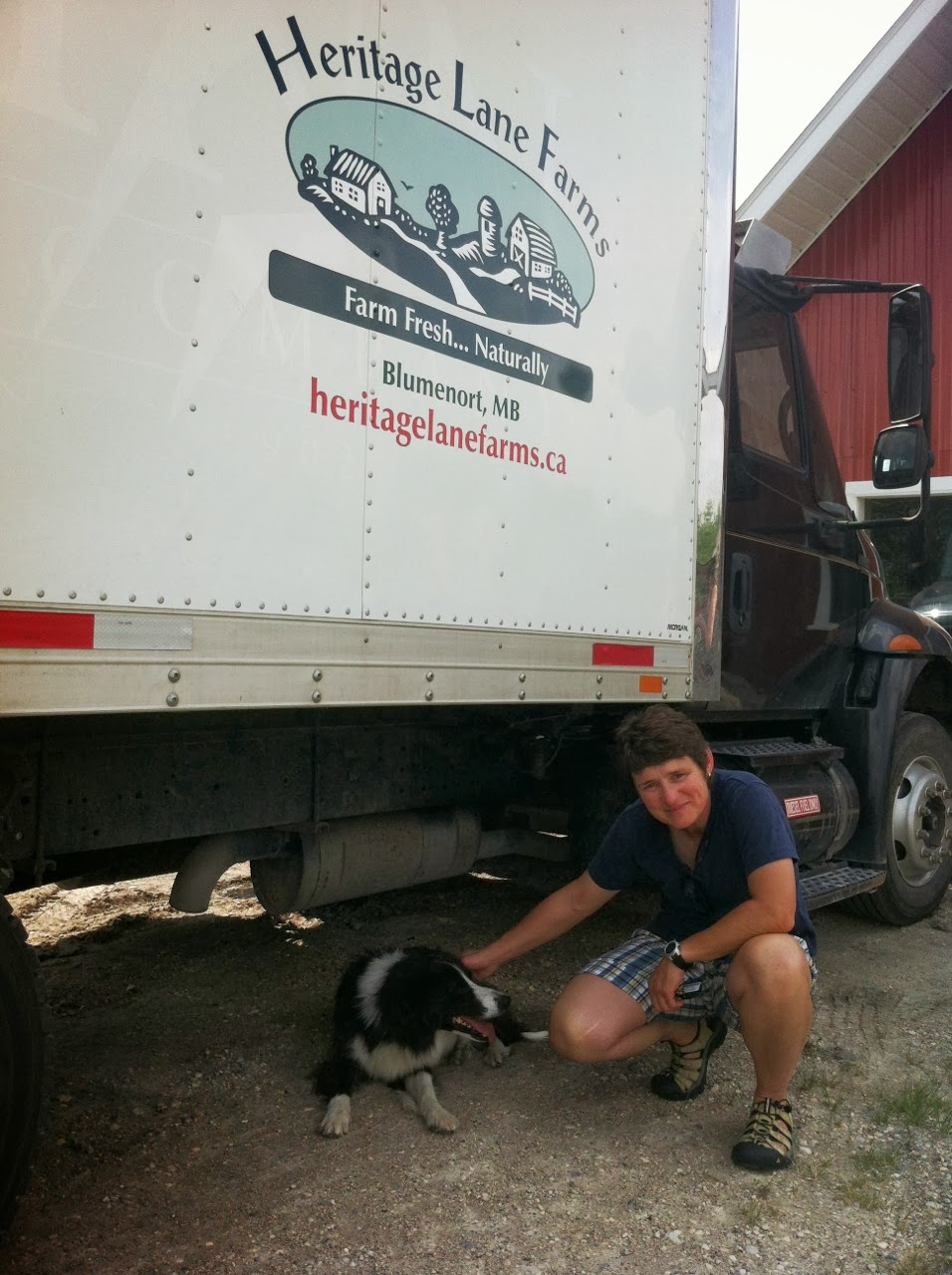
On August 24, as part of Augustine's summer fundraising program, Just Living hosted a tour to two farms, where the farmers practice ethical farming.  The farms are separate operations, but are farmed by two generations of the same family.  We started with Benjamin Pries, and after lunch visited the farm of Albert and Pam Peters-Pries.  These are just a few pictures of the event, which was enjoyed by all who participated.

Cori and Christine eager to depart
At Benjamin's chicken coop

Benjamin raises turkeys, to be ready for Thanksgiving
Eggs delivered free range

Raising heritage variety pork:  Berkshire

Benjamin explaining the challenges of being a young, sustainable farmer

Albert's garden is his pride and joy.

Albert explains that he decided to become a farmer as a young teen.

Michele getting close and personal with the farm dog.

Heritage Lane Farms chickens are free range.  No antibiotics or animal-byproducts are used in the process.

Heritage Lane chickens are available at many stores in Winnipeg.


Sunday, 8 September 2013

Menno Simons College Esau Lecture Series


How  we Grow, Share and Eat

Moving Toward Just and Sustainable Food and Farming Systems

Menno Simons College Esau Lecture Series


Fall Public Lectures


ALL Public Lectures 7:00 to 9:00 pm, Eckhardt-Gramatté Hall, The University of Winnipeg


September 26, 2013

Changing Agriculture to Sustain the World: A Sequel
Dr. Martin Entz, University of Manitoba 

Professor Entz is the co-chair of the first Canadian Organic Science Conference, held in Winnipeg in February 2012. He completed his PhD at the University of Winnipeg in drought physiology, and maintains an interest in international development. Entz has done international development work in North Korea and has traveled all of the world’s continents to observe how sustainable agriculture is performed. His research interests include organic cropping systems, long term organic vs. conventional crop production systems, farmer participatory organic crop breeding, crop-livestock integration, and tropical agriculture.

October 24, 2013

Harvest of hope and food sovereignty in northern Manitoba

 Dr. Shirley Thompson, University of Manitoba 

Dr. Shirley Thompson is an associate professor at the Natural Resources Institute, University of Manitoba. Dr. Thompson has a PhD in Adult Education and Community Development and for the last four years and is a board member of Food Secure Canada and the Association of Nonprofit and Social Economy Research. In the past ten years Dr. Thompson has published 18 papers in refereed journals in press or published and one co-edited book as well as a number of videos. Dr. Thompson is working with 4 Island Lake Communities as Principal investigator for traditional land use planning and occupancy studies for sustainable community development. 

November 21, 2013
Feeding the world: is hunger inevitable?
Dr. Haroon Akram-Lodhi, Chair & Professor of International Development Studies, Trent University; and author of: Hungry for Change: Farmers, Food Justice and the Agrarian Question
Trained as an economist, the focus of Dr. Akram-Lodhi's research interest is in the political economy of agrarian change in developing capitalist countries, on the economic dimensions of gender relations, and on the political ecology of sustainable rural livelihoods and communities in contemporary poor countries. Haroon Akram-Lodhi's most recent book is Hungry for Change: Farmers, Food Justice and the Agrarian Question.

- submitted by Ruth


Thursday, 30 May 2013

Book Launch - The Stop - McNally Robinson, June 6

Nick Saul -- Speaking & Signing

Thursday Jun 06, 2013 7:30 pm - McNally Robinson in the Travel Alcove, Winnipeg

Speaking & Signing The Stop: How the Fight for Good Food Transformed a Community and Inspired a Movement (Random House of Canada).

Nick Saul -- Speaking & Signing Nick will share stories from his 14 years at The Stop, a progressive food organization that uses good food to build health, hope and community, and that has inspired a movement of Community Food Centres in cities — including Winnipeg — across the country.

Co-author Nick Saul was executive director of The Stop Community Food Centre in Toronto from 1998 to 2012 and is a recipient of the prestigious Jane Jacobs Prize and the Queen’s Jubilee Medal. He is now president and CEO of Community Food Centres Canada, an organization that will bring the innovations of The Stop to communities across Canada.


Here is part of the promotional material advertising this book launch:
 
In 1998, when Nick Saul became executive director of The Stop, the little urban food bank was like thousands of other cramped, dreary, makeshift spaces, a last-hope refuge where desperate people could stave off hunger for one more day with a hamper full of canned salt, sugar and fat. ...

Since that time, The Stop has undergone a radical reinvention. Participation has overcome embarrassment, and the isolation of poverty has been replaced with a vibrant community that uses food to build hope and skills, and to reach out to those who need a meal, a hand and a voice. It is now a thriving, internationally respected Community Food Centre with gardens, kitchens, a greenhouse, farmers' markets and a mission to revolutionize our food system. Celebrities and benefactors have embraced the vision because they have never seen anything like The Stop. Best of all, fourteen years after his journey started, Nick Saul is introducing this neighbourhood success story to the world. 

 This event presented by Community Food Centres Canada, NorWest Co-Op, and Food Matters Manitoba.

Sunday, 26 May 2013

Food Secure Canada

Food Secure Canada - "Where agriculture, environment, health, food and justice intersect"


Check out this link to learn more about this organization.  Here is the Vision from their website.  This link has also been added to the Recommended Website list.

Food Secure Canada is based in three interlocking commitments:

Zero Hunger: All people at all times must be able to acquire, in a dignified manner, adequate quantity and quality of culturally and personally acceptable food. This is essential to the health of our population, and requires cooperation among many different sectors, including housing, social policy, transportation, agriculture, education, and community, cultural, voluntary and charitable groups, and businesses.

A Sustainable Food System: Food in Canada must be produced, harvested (including fishing and other wild food harvest), processed, distributed and consumed in a manner which maintains and enhances the quality of land, air and water for future generations,  and in which people are able to earn a living wage in a safe and healthy working environment by harvesting, growing, producing, processing, handling, retailing and serving food.

Healthy and Safe Food: Safe and nourishing foods must be readily at hand (and less nourishing ones restricted); food (including wild foods) must not be contaminated with pathogens or industrial chemicals; and no novel food can be allowed to enter the environment or food chain without rigorous independent testing and the existence of an on-going tracking and surveillance system, to ensure its safety for human consumption.