Showing posts with label Purchasing Ethically (Misc). Show all posts

Monday, 30 November 2015

Short Answers to Hard Questions About Climate Change

This from the NY Times:


"The issue can be overwhelming. The science is complicated. Predictions about the fate of the planet carry endless caveats and asterisks. 
We get it. 
And so, as the Paris climate talks get underway, we’ve provided quick answers to often-asked questions about climate change.


You can find the twelve questions and answers by clicking here.

-submitted by Gareth

Monday, 2 November 2015

"Just" Christmas, Nov 15

The 2015, 8th annual event will take place on NOVEMBER 15TH from 1-3:30 at
     Gordon-King Memorial United Church, 127 Cobourg Avenue in East Kildonan.
You’re welcome to come get your Christmas shopping done in Just one Place all for Just causes and with Justice focused organizations. 
Check out all the vendors! Including us at 1JustCity and watch for our catalogue online soon!

Thursday, 20 March 2014

"Thank you, Mom"? Thanks for nothin'


http://www.greenpeace.org/usa/ReSizes/OriginalWatermarked/Global/usa/image/2007/11/orang-utan-at-the-borneo-orang.jpg
Image Source:  Greenpeace


The orangutans of Indonesia are endangered and now their last chance at survival is vanishing fast.

Procter & Gamble's video was watched by millions all over the world. Now everyone needs to know that deforestation to create palm oil plantations means orangutans are senselessly orphaned.

While Procter & Gamble were advertising about motherhood, companies that produce their palm oil have been making orphans out of orangutans. During the Winter Olympics the makers of Head & Shoulders ran an advertising campaign called "Thank you, Mom" to talk about how their products help mothers raise their children.

But we've made a video of the dirty secret Procter & Gamble don't want you to see. It's all about what they call "sustainable" practices. Click here to watch and share the video.

Procter & Gamble uses palm oil linked to the destruction of Indonesia's forests. Deforestation for palm oil plantations takes orangutans away from where they were born, destroying the place where they once lived. This dirty palm oil is in products you probably use every day.

- Submitted by Bev


The Oilsands-Inspired Creation that Looms in Washington

Winnipegger Mia Feuer's art reflects the 'sculptural' transformation of Alberta's landscape.
From The Tyee, 23 Jan 2014
By Andrew Nikiforuk 

Mia Feuer sculpture
Image Source:  Kate Warren, The Tyee

Reviewers alternatively call the Washington, D.C. exhibit dystopian, eerily beautiful, or a "nightmarish manifestation" of environmental ruin.

In particular, many are attracted to the ominous black skating rink that occupies the rotunda. The plastic rink may or may not be a metaphor for oil's grip on Canadian politics.

Others are awed by a giant (40-feet by 40-ft. by 30-ft.) sculpture that hangs over the rink. Composed of a riot of suspended trees, oil field junk, tar paper and black birds, it resembles some strange, Harry Potter-like hallucination.

...

Winnipeg-born sculptor Mia Feuer [from Winnipeg's North End] calls her bitumen-inspired creation "An Unkindness," after a gathering of ravens. She says that artists have a duty to respond and reflect upon the times we live in.

"We just can't all be making beautiful things," Feuer says.

...

[Feuer toured some of the tarsands in Alberta in preparation for her exhibit.]   During her tour, Feuer got a glimpse of so-called reclaimed sites.

After digging up low-lying peat lands, fens and rivers to mine bitumen, industry replaces complex boreal landscapes with artificial, man-made hills made with layers of mining waste, including petroleum coke and salt-laden sands.

The process also includes dumping toxic mining waste into pits and then capping the pits with freshwater: an untested form of reclamation.

Because peatlands, which occupy 65 per cent of the mineable area, take 10,000 years to make, there is no requirement for industry to restore them. Nor is there any legal requirement to replace wetlands with wetlands, as most industrial nations now mandate, because of the high cost to industry -- up to $12 billion.

After building sandy uplands, industry then attempts to grow salt-tolerant plants on engineered soils. Scientists calculate that it may take 200 years to determine if the man-made sculptures can survive droughts, forest fires, erosion, insects, pathogens, or bitumen pollutants.

The reclamation sites gobsmacked Feuer. "I stood in a land that was once boreal forest, that was now a bunch of toxic wheat grown in toxic earth," she says.

The wheat, an attempt to build some vegetation cover, invited a mice plague. One company, in turn, sought to control the rodent epidemic by planting trees upside down, with their roots sticking in the air. The trees gave mice-hunting ravens a place to perch. (Since 1977, industry has blamed meadow voles and deer mice for slowing reclamation efforts.)
 
It all looked like some "twisted-demented nursery rhyme," says Feuer. And it inspired a huge sculpture that now greets visitors at [the exhibit in Washington DC].

You can read the entire article by clicking here.

-Submitted by Kathleen

Worse than Walmart:

Amazon’s sick brutality and secret history of ruthlessly intimidating workers 

You might find your Prime membership morally indefensible after reading these stories about worker mistreatment
From Salon.com, February 23, 2014
Written by Simon Head

Excerpted from the book "Mindless:  How Smarter Machines are making Dumber Humans"

When I first did research on Walmart’s workplace practices in the early 2000s, I came away convinced that Walmart was the most egregiously ruthless corporation in America. However, ten years later, there is a strong challenger for this dubious distinction—Amazon Corporation. Within the corporate world, Amazon now ranks with Apple as among the United States’ most esteemed businesses. Jeff Bezos, Amazon’s founder and CEO, came in second in the Harvard Business Review’s 2012 world rankings of admired CEOs, and Amazon was third in CNN’s 2012 list of the world’s most admired companies. Amazon is now a leading global seller not only of books but also of music and movie DVDs, video games, gift cards, cell phones, and magazine subscriptions. Like Walmart itself, Amazon combines state-of-the-art CBSs with human resource practices reminiscent of the nineteenth and early twentieth centuries.

Amazon equals Walmart in the use of monitoring technologies to track the minute-by-minute movements and performance of employees and in settings that go beyond the assembly line to include their movement between loading and unloading docks, between packing and unpacking stations, and to and from the miles of shelving at what Amazon calls its “fulfillment centers”—gigantic warehouses where goods ordered by Amazon’s online customers are sent by manufacturers and wholesalers, there to be shelved, packaged, and sent out again to the Amazon customer.


http://bbpbooks.teachingforchange.org/files/teachingforchange/amazonwarehouse.jpg
Amazon’s shop-floor processes are an extreme variant of Taylorism that Frederick Winslow Taylor himself, a near century after his death, would have no trouble recognizing. With this twenty-first-century Taylorism, management experts, scientific managers, take the basic workplace tasks at Amazon, such as the movement, shelving, and packaging of goods, and break down these tasks into their subtasks, usually measured in seconds; then rely on time and motion studies to find the fastest way to perform each subtask; and then reassemble the subtasks and make this “one best way” the process that employees must follow.

...

In December 2009 Mark Onetto, chief of operations and customer relations at Amazon and a close collaborator of Bezos, gave an hourlong lecture on the Amazon Way to master’s of business administration students at the University of Virginia’s Darden School of Business. Onetto is a disconcerting figure, because once he starts talking, style and substance are in sharp contrast. He is French born, and he still speaks with the rather faded insouciance of Maurice Chevalier and “Gay Paree,” and he makes much of this in his lecture. But there was nothing gay (in the traditional sense) or insouciant about the Amazon workplace that Onetto described for UVA’s MBA candidates.

Like most such corporate mission statements, Onetto’s uses a coded language that hides the harshness of his underlying message, which needs translation along with a hefty reality check. As with Walmart so at Amazon, there is a quasi-religious cult of the customer as an object of “trust” and “care”; Amazon “cares about the customer,” and “everything is driven” for him or her. Early in the lecture, Onetto quotes Bezos himself as saying, “I am not selling stuff. I am facilitating for my customers to buy what they need.”

...

Whereas some Amazon employees are in constant motion across the floors of its enormous centers—the biggest, in Arizona, is the size of twenty-eight football fields—others work on assembly lines packing goods for shipping. An anonymous German student who worked as a temporary packer at Amazon’s depot in Augsburg, southern Germany, has given a revealing account of work on the line at Amazon. Her account appeared in the daily Frankfurter Allgemeine Zeitung, the stern upholder of German financial orthodoxy and not a publication usually given to accounts of workplace abuse by large and powerful corporations. There were six packing lines at Amazon’s Augsburg center, each with two conveyor belts feeding tables where the packers stood and did the packing. The first conveyor belt fed the table with goods stored in boxes, and the second carried the goods away in sealed packages ready for distribution by UPS, FedEx, and their German counterparts.
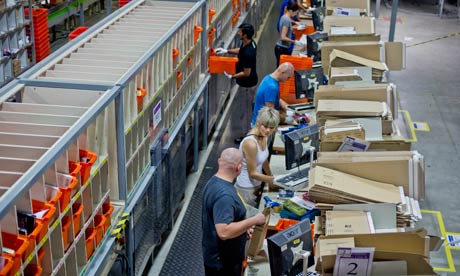

Staff at Amazon's Marston Gate warehouse.
Image Source:  Sarah Lee, The Guardian
Machines measured whether the packers were meeting their targets for output per hour and whether the finished packages met their targets for weight and so had been packed “the one best way.” But alongside these digital controls there was a team of Taylor’s “functional foremen,” overseers in the full nineteenth-century sense of the term, watching the employees every second to ensure that there was no “time theft,” in the language of Walmart. On the packing lines there were six such foremen, one known in Amazonspeak as a “coworker” and above him five “leads,” whose collective task was to make sure that the line kept moving. Workers would be reprimanded for speaking to one another or for pausing to catch their breath (Verschnaufpause) after an especially tough packing job.

...

A significant portion of the article has been reposted here.  There's more.  You can read the entire article by clicking here.

Note:  It is not hard to find other articles critical of worker conditions at Amazon.com.  The book, Mindless, written by Simon Head and from which this is excerpted, focuses at least in part on abuses such as these.  You can read a short but excellent review of that book, by clicking here.  A quote from the review:  [Head] argues that ... computerized management programs that Amazon and other large organizations use to measure everything that happens in factories, warehouses and depots—are turning workers into “digital chain gang” members who work harder and earn less. Once limited to tracking blue-collar productivity, CBSs now engulf much of the white-collar world, where they control the complex work of physicians, teachers and others in the professional and administrative middle class.

-Submitted by Gareth

Monday, 23 December 2013

The high price of cheap gas

This article has been reposted from Treehugger.com.  You can read a related article in the Atlantic.

A new study by Lucas Davis shows a wide variance in gas prices, depending on taxation or subsidies.

gas graph
(Copyright: Lucas Davis - Reposted from Treehugger.com)
The figure reveals an enormous amount of variation in gasoline prices. Gasoline prices average $5.26 per gallon, but range from $.09 per gallon in Venezuela to above $9.00 in Turkey and Norway. ... This wide variation in prices is somewhat surprising because crude oil and refi ned products are widely traded internationally, so the opportunity cost of fuels is similar everywhere. Although there are diff erences in transportation, refi ning, and distribution costs, they can explain only a small part of the observed variation in prices. Instead, the more important explanation for the wide variation in fuel prices is that taxes and subsidies diff er widely. Among OECD countries, gasoline taxes per gallon range from an average of $0.49 in the United States, to above $4.00 in Germany and the Netherlands.
Here it is shown another way, from a different study, where the relation of price to consumption is even more stark.


The federal gas tax in the United States has not been raised since 1993. It is supposed to provide the money for the Highway Trust Fund that maintains roads and bridges, but doesn't raise enough. So Congress funds $ 50 billion from general revenue to make up for the shortfall, essentially a giant subsidy that keeps the price of gas low.

- Submitted by Gareth


Wednesday, 11 December 2013

The myth of the perfect gift

From Treehugger, Dec 9, 2013
by David Friedlander

Are you looking for the perfect gift this holiday season? Look no further. It doesn’t exist. As we reported the other day, Americans spend between 3-4% of their annual income on Christmas season gifts. The objective of this considerable allocation of funds, we might assume, is to give things to the people we love and like that will enrich their lives–things they will appreciate, use and enjoy.
The reality is something quite different. A Psychology Today article reports sobering information about the psychology of gift giving and receiving. Authors Ben C Fletcher and D Phil Oxon cite Professor Karen Pine’s research about festive gifts, which found that:
  • 89% of women and 79% of men pretended to like a gift they hated.
  • Half of all people had received at least one gift they hated the previous Christmas.
  • Half of all people have lied to a loved one about a gift, pretending to like it.
  • Gift receivers reported avoiding eye contact with the giver for fear of revealing how they really felt.
  • Gift receivers reported producing fake smiles using only the mouth (not the eye) muscles when pretending to like a gift.
This was reposted in Treehugger from Life Edited.  You can read the entire article by clicking here. 

- submitted by Gareth


How to take control of consumerism during the holiday shopping season

From Treehugger, Dec. 6, 2013
Tom Szaky, Guest Writer

Let's start with a simple fact: Humans are proven to prefer consumerism.

Any economist will agree that consumerism is essential for the culture of capitalism to survive. Not only must consumers buy, they must buy more every year, and still more the year after that. Without perpetual and growing consumption, many economies would either decline or collapse. The sign of a healthy national economy, after all, is measured by the Gross National Product (GNP), and the GNP is a measure of the quantity of goods and services people consume.

So are we all in the service of consumerism? I would argue yes.

If you look at it most jobs in the world are in the service and facilitation of consumerism. Everything from the common factory worker in China to the sales associate at your Macy’s to most lawyers, accountants, real estate agents etc. Without consumption we probably couldn’t support the 7 billion people that live on our planet.

But we don’t have to be indentured servants to consumerism. We are servicing consumerism voluntarily. No one is making us buy anything. We are choosing to do so – be it for ease or comfort or simple malaise.

You can read the entire article by clicking here.

- submitted by Gareth

Thursday, 28 November 2013

Social Purchasing Shopping Tour (Dec. 11)

2nd Annual Holiday Shopping Bus Tour

The Social Purchasing Portal is offering a tour similar to Augustine's Ethical Shopping Tour.  For those who aren't finished after Augustine's tour on December 7, or if you have a conflict on the 7th, you can register for this one on Wednesday, Dec. 11.  It says that space is limited, so register ASAP.


For more information CLICK HERE.
-submitted by Gareth