Showing posts with label Care for Earth. Show all posts

Monday, 30 November 2015

Short Answers to Hard Questions About Climate Change

This from the NY Times:


"The issue can be overwhelming. The science is complicated. Predictions about the fate of the planet carry endless caveats and asterisks. 
We get it. 
And so, as the Paris climate talks get underway, we’ve provided quick answers to often-asked questions about climate change.


You can find the twelve questions and answers by clicking here.

-submitted by Gareth

Tuesday, 25 August 2015

Crude Awakenings


Darren Dochuk, Associate Professor in the Department of History at the University of Notre Dame
Oil has always enchanted Americans, and inspired them to think about their society’s future in sacred terms. Extracted from the earth in mysterious ways, often with the help of spiritualist devices and prayer, oil was at its origins imagined as the divinely sanctioned lifeblood of a modernizing nation. America’s powerbrokers and rank-and-file together ascribed a special status to this abundant material, and in turn used its wealth to construct and legitimate imposing corporate and church institutions, missionary organizations, and an expansive petro-state. Indeed, the concept of the “American Century,” commonly used to describe this nation’s hundred-year ascendancy, is itself a product of petroleum and religion’s arresting reciprocity. When missionary son and magazine publisher Henry Luce coined the term in 1941, he did so fully aware of how his fellow citizens drew special assurance from oil’s seemingly divine potentials, and attached them to a politics of exceptionalism. Luce also knew that as much as oil was America’s blessing and the source of its leadership in the world, it was also a burden that came with costs to the nation and its people, and the land they inhabited. 
Following Luce’s lead, but with an eye to wider and longer trends, and a continental terrain centered by the United States but also encompassing Canada, these lectures will explore some of the ways that religion and oil together shaped existence for modern North Americans at the moment of their heightening authority in the twentieth century. It will pay particular attention to evangelical Protestants who, in disproportionate degrees, inhabited and worked America’s oil patches, weathered the violent disruptions of life on these boom-bust terrains, and theologized and politicized their encounter with soil and its subsurface wealth and all that this seemed to promise them, on earth and in heaven. 
Posted by Gareth

Monday, 18 May 2015

Canada's Shameful Exports

Fifty years of bloody conflict, economic greed, and environmental devastation

Sojourners Magazine, May 2015
By Emilie Teresa Smith

This article examines horrendous Canadian mining practises in Guatemala, the Philippines, Chile, Argentina, Paua New Guinea, Tanzania, D.R. Congo, El Salvador. 

CANADIAN MINING companies have left a trail of destruction around the world—mostly in places where people are poor and vulnerable.
The earliest conflicts caused by Canadian mining exploded in Guatemala in the early 1960s when the nickel company Inco dug into the northern mountainside of Guatemala’s largest freshwater lake, Lago Izabal. Almost 155 square miles of traditional Kekchi-Maya land was expropriated to create Inco’s Exmibal mine. As the region descended into bitter war, Guatemalan oligarchs and their military, with the support of Canadian-mining and U.S. geopolitical interests, exterminated all popular dissent. Dozens of Kekchi leaders were killed or disappeared; four prominent leaders who had published a report condemning the Inco-Exmibal deals were brutally assaulted and two of them assassinated. The Exmibal mine operated for three years before Inco abandoned it, never paying a nickel in royalties to Guatemala.

Image Source:  UC Observer
Meanwhile, in the Philippines, Vancouver-based Placer Dome arrived on Marinduque Island and sunk in a filthy copper mine. Over the next three decades, Placer Dome operated the Marcopper mine, devastating the local environment and its communities. From 1975 to 1991, Placer Dome dumped 200 metric tons of toxic waste into Calancan Bay, and in March 1996 a massive rupture from the tailings pond flooded 60 villages with toxic waste, permanently destroying community lands, rice fields, and shrimp marshes. The Boac River was declared dead, and the U.N. pronounced it a major environmental disaster. The entire Marcopper mine project was abandoned; no major attempt at clean-up ever took place. In 2006, Placer Dome was taken over by the giant, Toronto-based Barrick Gold, one of the world’s largest mining companies. In 2008, the provincial government of Marinduque began a lawsuit, but Barrick has fussed and delayed, dragging the court case on endlessly.
Barrick is also responsible for the massive $8.5 billion boondoggle of the Pascua Lama gold mine. Saddled in the Andes between Chile and Argentina,the mine threatens to blow up hundreds of glaciers and drastically impact the Atacama Desert—one of the driest regions of the world. In response to the long-ignored concerns of Diaguita Indigenous communities and others, the Chilean government eventually suspended Barrick’s license, but glaciologists report that the pre-mining activity has already wreaked irreversible destruction in the area.
Papua New Guinea hosts the massive Barrick Porgera mine, built right on top of local Ipili communities; multiple claims of grave human rights violations have been reported. Bought-off police and mining company security guards have been accused of murder, beatings, home burnings, and gang rape. The former chair of Barrick, Peter Munk, was quoted in a Canadian newspaper in 2011 that “gang rape is a cultural habit [of the traditional people of Papua New Guinea]. Of course, you can’t say that because it’s politically incorrect.”
Horrendous violence has also been reported at Barrick’s mine in Tanzania. And shadows of the same story emerge inD.R. Congo: Security guards for Montreal’s Anvil mines have been accused of providing cover for government soldiers engaging in the massacre of civilians. In El Salvador, Vancouver’s Pacific Rim (now OceanaGold) sued the Salvadoran government, claiming that the country violated international trade law by refusing to allow the company to dig a massive gold mine that would have drastically polluted the country’s thin water supplies. Four community activists of the Cabañas region, where the project was to go in, have been murdered, including Dora Alicia Recinos, who was eight months pregnant when she was shot dead.

The common denominators in these countries and elsewhere are corrupt local officials with ready access to people-controlling violence—a perfect environment for Canadian mining. The low-paying jobs, taxes, royalties, and other economic gains in the short term in no way compensate for permanent environmental devastation and community conflict inevitably caused by mining.


- Submitted by Gareth

Oh, Canada!

Canadians are supposed to be the good guys in the story. Well, not anymore.

Sojourners - May 2015
by Emilie Teresa Smith

DOÑA DIODORA STANDS on the side of the mountain, shivering. She’s tending to her skinny cows. A simple adobe hut stands here on the edge of her land in the Guatemalan highlands—“so I can stay and look after the animals,” she says. “But I don’t know what I am going to do about water. They’ve taken away the water.”

Tears drip down out of her good eye. She dries them on a thin sleeve. The other eye socket, shattered where the bullet went through, seeps with yellow pus. “Me siento un poco triste—a little sad,” she explains in her halting, quiet Spanish. It is cold on the mountain, achingly so. And, mysteriously, the water has gone: Old streams and wells are dusty. The cows look ill.


Photo Source:  Sojourners Magazine

Just down the crumbling mountain, the tailings pond from the Marlin mine glows a weird shade of neon green.
I first heard about the Marlin mine—operated by Vancouver’s Goldcorp—in 2005, before it opened. That year I was going to Guatemala with a youth group from my diocese, and we were warned: Don’t wear anything that identifies you as Canadians. What? Canadians? We’re supposed to be the good guys in the story. Well, not anymore.


The great global economic shift in the mid-1990s, a free-for-all (if you were already rich) of unbridled neo-liberal capitalism, unleashed an invigorated predatory wave of miners—from Canada—all around the planet to sniff out new places to dig. Canada is the place to raise venture mining capital—the heaps of cash needed to fund these monstrously expensive projects.

Canada has few laws or functioning regulations to control investments or protect human rights and the environment far from our shores. Thus it’s not surprising that 75 percent of international mining companies are registered in Canada and 60 percent are listed on Canadian stock exchanges. In Latin America alone there are around 1,500 mining projects, involving 230 Canadian companies.
Mining Watch, Canada’s top mining observer, has documented that 90 of these companies are involved in 200 conflicts. The main points of contention are water contamination and drastic depletion, land expropriation and devastation, and the lack of community consultation.
Local populations have massively rejected these exploitative practices. They have seen it all before: Promises of jobs, money, and progress, followed by the realities of shattered lives and never-cleaned-up toxic waste. Doña Diodora was shot by midnight strangers at her door, after she openly resisted the Marlin mine for more than five years, refusing to sell her land and refusing to shut up.
I have seen these often-deadly clashes in the flesh—in Guatemala, where I have lived off and on for many years, and then up and down the spine of Latin America. In 2012, I was elected co-president of a historic network of liberation theologians and practitioners that formed in the aftermath of the martyrdom of Archbishop Oscar Romero. In that capacity I have visited El Salvador, Guatemala, Mexico, Argentina, Haiti, and the Dominican Republic. In each country, as I stepped off the plane, community leaders came to me wanting to talk about the conflicts around Canadian mining in their country. Walls sprayed with graffiti presented me time and again with the unhappy message: “Mineras canadienses—OUT!”
Providing shelter for industry
Meanwhile, back in Canada, there have been numerous attempts to create control mechanisms for mining behavior. They have all met with obfuscation and obstruction. In 2009, a private members bill (Bill C 300, for Corporate Accountability for the Activities of Mining in Developing Countries) was brought to the Canadian parliament. Mining companies rushed to fund and organize some of the most intense lobbying ever seen in Ottawa. The bill was defeated.
The government of Canada, especially under the nine-year reign of ultraconservative Stephen Harper, has dedicated itself to the promotion of mining companies around the world. While community, environmental, and religious groups have rallied on every front, both in Canada and in the ravaged countries where the mines are going in, the Canadian government has showered resources—diplomatic, legal, and economic—to shelter industry.
The only government response to growing demands for mandatory controls on mining companies has been the creation of a toothless Office of the Extractive Sector Corporate Social Responsibility (CSR) Counsellor. The office, set up “to assist stakeholders in the resolution of CSR issues pertaining to the activities of Canadian extractive sector companies abroad,” has seen four cases in the five years since its creation—and not a single conflict has been resolved, not even remotely. The complaint and review process is completely voluntary on the part of industry; in all of the cases brought forward, the company has simply refused to participate. The Counsellor office has operated as a screen to greenwash the hopelessly destructive practice of modern mining.
Canadian nongovernmental organizations pushing to hold mining companies accountable (such as the Catholic group Development and Peace and the ecumenical Kairos Canada) have had their government funding slashed. Other NGOs (such as World Vision-Canada and Plan Canada) have accepted more than $6.5 million—of Canadian taxpayers’ money—to in effect run the companies’ CSR programs and, in the process, help to pacify local resistance movements around the world.
Most Canadian citizens are blithely unaware of what is happening in our name. We have bought into the idea that what is wrong in the world is “underdevelopment,” not rampant greed on the part of an ever-decreasing minority. In the “mercantile cosmology,” where the whole world is for sale and nothing is worth anything if it isn’t marketable, international mining blasts a “win-win” rhetoric that carries the day.
A stroll around Toronto or Vancouver reveals the depth to which mining enterprises—while sabotaging mandatory regulations—have purchased the consent of the Canadian public. In British Columbia, for example, Goldcorp nestles its money and its name into the Vancouver Opera Society, the Vancouver Symphony Orchestra, the Aquarium, the Tap Society, Science World, Bard-on-the-Beach, Arts Umbrella, Big Brothers, YMCA, the Nature Trust of British Columbia, the Special Olympics, the Heart and Stroke Foundation, the Goldcorp Mental Health Centre, every major Vancouver hospital, Simon Fraser University, and the University of British Columbia. Community, health, education, and arts institutions—in desperate straits due to drastic funding cutbacks—are anxious to take the money. Goldcorp acts as a “good corporate citizen,” and Canadians nod in agreement.
Another way citizens are enmeshed—often without knowing—in controversial international mining projects is through deep ties between industry and pension plans. The national government Canada Pension Plan, to which every working Canadian makes monthly contributions, is one of the largest group investors in Goldcorp. Trade union, teacher, and other public servant union pension plans are not far behind, holding heavy investments in numerous mining corporations. Even churches have their fingers in this sticky, money-making pie.
Resisting the onslaught
Around the world (see “Canada’s Shameful Exports,” previous page), open—and costly—resistance to massive mining projects has arisen since the beginning of the Canadian invasions. While industry appears to have every advantage on its side, determined individuals and groups have created strategic campaigns in defense of their territories.
In Guatemala, Mayan communities have launched dozens of public consultations, availing themselves of both traditional decision-making models and international agreements. They have vigorously applied Convention 169 of the International Labor Organization’s code on the rights of Indigenous and Tribal Peoples. In more than 85 communities, upwards of 1 million Guatemalan citizens have studied, debated, and finally voted on whether or not to accept extractive industries in their territory. Their resounding answer: No.
There has been a rising tide of organized defense of territory by communities across Canada as well. About 200 miles from where I live, there is a sacred lake, known to the Tsilhqot’in people as Teztan Biny and to English speakers as Fish Lake. It is home to 85,000 rainbow trout. Vancouver-based Taseko Mines crafted a plan to use Teztan Biny as a tailings pond, to hold the dirty water from their proposed “Prosperity Mine.” The Tsilhqot’in people and their supporters were having none of it. They organized a years-long campaign of study and defense and, finally, in February 2014 the project was rejected by the federal minister of the environment.
The resistance of the Tsilhqot’in people was a prophetic act: Six months after the federal decision, the holding wall of the Mount Polley Mine tailings pond—only 82 miles from Teztan Biny—ruptured. In the biggest mine spill in Canadian history, waste water and toxic sludge burst out, destroying Hazeltine Creek and pouring into the deep, pristine Lake Quesnel.
It isn’t surprising that the struggle to protect the earth has been taken up by Indigenous communities and others who live close to the soil—and the cycle of creation, growth, and decay upon which it depends. Motivated by a deep love for the land, these communities have supplied a critical challenge to the dominant story that progress and right-living necessarily depend on the destruction of creation.
Theirs is a loud proclamation of a different truth: The Earth is not a thing to be bought, sold, used, and destroyed. Our eternal connection to the dust is that we are dust. We are not the Creator, but frail creatures, utterly dependent on the care of the Earth, her mountains, her water, streams, and deepness underground. As the psalmist reminds us, the Earth is not ours, but God’s; we live with tender mercy and grace upon her abundant belly. 
Emilie Teresa Smith, an Argentine-Canadian Anglican priest, is co-president of the Oscar Romero International Network in Solidarity with the Peoples of Latin America. She is working on a book about Canadian mining companies in Guatemala.
- Submitted by Gareth

Tuesday, 21 April 2015

Orientation on No Energy East Campaign by Manitoba Energy Justice Coalition


Join us and learn how you can stop the energy east pipeline and stop the tar sands.

This is an orientation session for people interested in joining or volunteering with MEJC.

This event is taking place in St Norbert because it is ground zero for the risks of ruptures in Winnipeg. 

Agenda will include:
History of the Group.
Pipeline 101
How to get involved in MEJC.

St. Norbert Community Centre, 3450 Pembina Hwy.
Sunday, April 26, 1-3 p.m.

For more information:


Wednesday, 10 September 2014

WATER - A Prayer

Karla shared this prayer at the end of August.  It is offered in this blog with her permission.


~Water~         Karla W

Creator God
Mother and Father of all that is
 
in humbleness and humility for all that is undeserving,
hear our fervent prayer.

We have grown thirsty from crying,
wandering the desert, troubled, delirious...far gone.
We see the water, yet do not drink.

Unclench our sticky, furled fists of greed so we may catch
one lone tear from your heavenly Grace.

Let it wash us clean so that we may, once again, feel the beauty of the earth...like children

eyes cleansed, restoring vision that clearly sees the gift of creation

let it run through our veins, blood of Christ...life giving forgiveness

quenching our insatiable thirst for the riches of the land and sea

give drink to our parched hearts, restoring the connected rhythm with all of creation.

Amen


- submitted by Gareth

Sunday, 25 May 2014

Canada's $207,000 oil sands ad: Putting a price on deception

From the Globe and Mail

This business column by Eric Reguly appeared in the May 10, 2014  Globe and Mail "Report on Business".  As we pick up our Saturday Globe, we usually are rather quick to deposit the Report on Business on the recycling pile (not sure that's a good idea or not).  This time the headline of the column by Reguly caught Kathleen's attention.  In the print version of the May 10 Globe and Mail, the secondary headline (on the continuation of the article on pg. 6) was:  "If Canada were responsible, it wouldn't blow small fortunes on deceptive ads".  We both found it interesting to find an article with this editorial position in the business section of the Globe.  The article begins like this:

The ad in The New Yorker is pretty, if not quite arresting. The full-page photo on the inside back cover – prime real estate in the United States’ leading upmarket magazine – features a pristine river meandering through a lush mountain valley, untouched by humanity. It is not a tourism ad. It is designed to convince influential Americans that the Keystone XL pipeline is environmentally safe, even desirable.

What is clever about the ad is not the photo; it is the headline and the succinct lines of copy beneath it. They are slick pieces of propaganda – misleading without being outright lies. Of course, advertising is all about propaganda. But this ad is unconscionable because you, the Canadian taxpayer, paid for it. The rate for a full-page ad in that location, according to Condé Nast, publisher of The New Yorker, is $207,000 (U.S.).

You can read the entire article by clicking here.

- Submitted by Gareth and Kathleen

Saturday, 22 March 2014

The Earth needs a good lawyer

By Brian Loffler
New Internationalist Magazine
March 5, 2014

The earth from space [Related Image]
Image Source:  Creative Commons

Once in a lifetime a truly game-changing event reshapes global society. Think back to 1833 when the British Parliament finally bowed to public pressure and the Slavery Abolition Act was passed. Now, in our lifetime, Polly Higgins is campaigning tirelessly to do for Earth Rights what the abolitionists did for Human Rights. And the goal is in sight. I spoke to Polly Higgins this week for an update.

(I've chosen a number of excerpts from the interview with Polly Higgins.  You can read the entire interview by clicking here.)

Brian: We’re always fascinated to know what motivates people; what got you started on a lifetime of activism?
Polly: In my student days I met the Austrian artist and ecologist Hundertwasser. He was a big part of my life then. I went to Austria specifically to seek him out for an interview for my Master’s thesis. He was an ecological thinker so much ahead of his time. He talked about things such as: trees have rights; nature has no straight lines, so neither should our architecture.

....

Ten years ago you were a regular lawyer appearing in the British court system, but that’s all changed. Why is that?
In 2005 I was a barrister representing a man who had suffered a serious workplace injury. There was a moment of silence while we were waiting for the judges, and I looked out the window and thought: ‘The Earth has been badly injured and harmed too, and something needs to be done about that.’ My next thought actually changed my life: ‘The Earth needs a good lawyer, too.’ When I looked around for the tools that I could use to defend the Earth in court, I realized those tools didn’t actually exist. But what if the earth had rights like we as humans have rights? International laws that criminalize genocide are now accepted as a valuable tool. Why couldn’t we also criminalize ecocide?

...

During your research you found that the UN had been considering introducing a crime against nature for decades. What went wrong?
In the lead-up to the adoption of the Rome Statute which led to the establishment of the International Criminal Court, there were to be five core international crimes: genocide, crimes against humanity, war crimes, crimes of aggression and ecocide. But last-minute lobbying – particularly by the US, Britain, Netherlands and France – saw ecocide dropped from the Statute.


  You can read the entire interview by clicking here.

- Submitted by Gareth

Once in a lifetime a truly game-changing event reshapes global society. Think back to 1833 when the British Parliament finally bowed to public pressure and the Slavery Abolition Act was passed. Now, in our lifetime, Polly Higgins is campaigning tirelessly to do for Earth Rights what the abolitionists did for Human Rights. And the goal is in sight. I spoke to Polly Higgins this week for an update.
Brian: We’re always fascinated to know what motivates people; what got you started on a lifetime of activism?
Polly: In my student days I met the Austrian artist and ecologist Hundertwasser. He was a big part of my life then. I went to Austria specifically to seek him out for an interview for my Master’s thesis. He was an ecological thinker so much ahead of his time. He talked about things such as: trees have rights; nature has no straight lines, so neither should our architecture.
- See more at: http://newint.org/blog/2014/03/05/polly-higgins-interview/#sthash.4n8BSs2L.dpuf

Trading water for fuel is fracking crazy

From the David Suzuki Foundation Blog
Feb 20, 2014
By David Suzuki with contributions from Ian Hanington, Senior Editor

Photo: Trading water for fuel is fracking crazy
Drought and fracking have already caused some small communities in Texas to run out of water altogether, and parts of California are headed for the same fate. (Image Credit: Merinda Brayfield)


It would be difficult to live without oil and gas. But it would be impossible to live without water. Yet, in our mad rush to extract and sell every drop of gas and oil as quickly as possible, we're trading precious water for fossil fuels.

A recent report, "Hydraulic Fracturing and Water Stress", shows the severity of the problem. Alberta and B.C. are among eight North American regions examined in the study by Ceres, a U.S.-based nonprofit advocating for sustainability leadership.

One of the most disturbing findings is that hydraulic fracturing, or fracking, is using enormous amounts of water in areas that can scarcely afford it. The report notes that close to half the oil and gas wells recently fracked in the U.S. "'are in regions with high or extremely high water stress' and more than 55 per cent are in areas experiencing drought. In Colorado and California, almost all wells — 97 and 96 per cent, respectively — are in regions with high or extremely high water stress, meaning more than 80 per cent of available surface and groundwater has already been allocated for municipalities, industry and agriculture. A quarter of Alberta wells are in areas with medium to high water stress.

Read the entire article by clicking here.

  - Submitted by Karla

Thursday, 20 March 2014

Which foods are the worst for the environment?

Although beef is always climatically costly, pork or chicken can be a better choice than broccoli, calorie for calorie.

From Toronto Star, March 20, 2014
Reprinted from the Washington Post, March 13, 2014
By Tamar Haspel

Any way you slice it, beef has the highest environmental cost of just about any food going, and the cow’s digestive system is to blame.
Any way you slice it, beef has the highest environmental cost of just about any food going, and the cow’s digestive system is to blame.  Image Source:  FREDERIC J. BROWN / AFP / GETTY IMAGES file photo

The argument that a vegetarian diet is more planet-friendly than a carnivorous one is straightforward: If we feed plants to animals, and then eat the animals, we use more resources and produce more greenhouse gases than if we simply eat the plants. As with most arguments about our food supply, though, it’s not that simple. Although beef is always climatically costly, pork or chicken can be a better choice than broccoli, calorie for calorie.

...

Comparing cows with pigs, and meat with plants, is often done using data from the Environmental Working Group, which produced a report in 2011 that detailed the environmental cost of meat. The report includes a chart that ranks various foods according to the amount of emissions generated in the course of production. Ruminants are the worst offenders, with lamb generating 39 kilograms of carbon dioxide (or its equivalent) for each kilogram of meat, and beef generating 27. Then come pork (12), turkey (11) and chicken (7). Plants are all lower, ranging from potatoes (3) to lentils (1).

But there’s another way to look at the same information. If you stop eating beef, you can’t replace a kilogram of it, which has 2,280 calories, with a kilogram of broccoli, at 340 calories. You have to replace it with 6.7 kilograms of broccoli. Calories are the great equalizer, and it makes sense to use them as the basis of the calculation.

When you reorder the chart to look at climate impact by calorie, the landscape looks different. The ruminants still top the chart, but the monogastrics look a whole lot better. Low-calorie crops like broccoli don’t do so well. Although beef still looks bad and beans still look good, pork and poultry are on a par with green vegetables. (Which means that a beef-and-leaf paleo diet is the worst choice going, environmentally speaking.)

...

The claim that vegetarianism is kinder to the planet also fails to consider a couple of kinds of meat that aren’t on the Environmental Working Group’s chart. Deer and Canada geese do active damage in the areas where they’re overpopulated, and wild pigs leave destruction in their path wherever they go. Eat one of those, and do the planet a favour.
Most people, though, are most likely to get their food from the farm, and it’s important to note that, although the chart attaches one number to each kind of food, farming styles vary widely and not all pork chops — or tomatoes, or eggs — are created equal. Unfortunately, it’s all but impossible for us consumers to figure out the climate impact of the particular specimens on our dinner table, whether they’re animal or vegetable.

---
 
There's a lot more in this article that serves as "food for thought" (I know, bad pun).  In some ways, I find it paralyzing, since it all becomes more complicated, and it's so much easier to simply conclude that if it's organic or local, or [even better] both, then I grab it.  Still, if knowledge is power (as some say), becoming informed about all the aspects to keep in mind, we'll all be empowered to make decisions that make sense (at least to ourselves).

You can read the entire article by clicking here. 

- Submitted by Gareth


How much is water worth to you?

Water is the most important natural resource on the planet. It sustains the land and the species that live there, including us. Yet each year there is less and less clean, fresh water available.

Here in Canada we are lucky. We have 20% of the earth’s surface fresh water and 9% of the country is covered in fresh water. That’s a lot of water! Which is why it is so important to ensure the protection of this vital resource.

This is where the Nature Conservancy of Canada (NCC) comes in. Across the country, NCC is working to protect wetlands, shorelines, riparian areas and other important fresh water ecosystems.

Image Source:  Screen shot of Nature Conservancy video

In British Columbia, NCC is working to protect land in the important Columbia Valley, where one of North America’s mightiest rivers – the Columbia – begins. This is the only stretch of the Columbia River that has been left unaltered by dams, and is part of the longest uninterrupted wetland in western North America. Unlike many other areas in the world, this region still supports a full suite of large native mammals, such as bear and cougar, elk and deer. NCC’s Columbia Lake – Lot 48 conservation area protects both a key stretch of lakeshore as well as a high-traffic wildlife corridor for elk, caribou, moose and bear.

On the opposite side of the country, NCC is doing important conservation work on The Grassy Place, a virtually pristine habitat at the headwaters of Robinsons River in southwest Newfoundland. The Grassy Place is the second largest project NCC has ever undertaken in Atlantic Canada and contains the largest wetland of its type in the province.

From east to west NCC is working to protect fresh water, ensuring lands surrounding important fresh water habitats are protected for the future and monitoring the health of these land’s fresh water resources.

But we could not accomplish all this alone! It’s thanks to concerned Canadians like you that we can engage in this important conservation work. Thank you so much!

To find out more about NCC’s work and how you can help, visit www.natureconservancy.ca

See the video by clicking here.

-Submitted by Karla

Moose and beavers do not stand on the shore applauding

From Winnipeg Free Press, January 27, 2014

By Will Braun

An artist's rendering of the Keeyask dam on the Nelson River. The project will be an extension of the overall hydro system.
An artist's rendering of the Keeyask dam on the Nelson River. The project will be an extension of the overall hydro system.  Image Source:  Manitoba Hydro

The Clean Environment Commission [has] concluded three months of numbingly detailed and occasionally passion-sparked hearings into the proposed Keeyask Dam.

....

The standard clean-hydro script was presented by Hydro at the Keeyask hearings. It was also showcased by Premier Greg Selinger in Washington, D.C., last February. Speaking to an audience at the Woodrow Wilson Center, Selinger portrayed Manitoba as a leader on climate and energy policy. He positioned Keeyask on this cutting edge, a benign source of energy to displace coal in the U.S.
He said the "legacy of bitterness" in the north has given way to a new era. New dams will be built in a way that not only reduces negative impacts, Selinger said, but uses them as "an opportunity to make environmental conditions better."

A remarkable claim.

What neither Selinger nor Hydro include in the official story, and what the CEC should include in its report, is this: A dam itself is no favour to the environment. Moose and beavers do not stand on the shore applauding as bulldozers roar and dynamite goes off.

Keeyask would involve pouring 870,000 tonnes of cement in the Nelson River. The work camps, roads, borrow pits and flooding would affect 14,000 hectares, not including the 1,400-kilometre Bipole III corridor.

...

Is Keeyask pushing the leading edge of energy and climate policy? Is it clean? Or is it a complex megaproject with potential benefits and serious consequences that need to be accurately described and thoughtfully weighed?

To echo a phrase from the closing argument of the Consumers Association of Canada at the hearing, hopefully the CEC report will "pierce the veil of Hydro branding."

Will Braun works for the Interchurch Council on Hydropower.

You can read Braun's op ed piece by clicking here.

- Submitted by Karla 

"Thank you, Mom"? Thanks for nothin'


http://www.greenpeace.org/usa/ReSizes/OriginalWatermarked/Global/usa/image/2007/11/orang-utan-at-the-borneo-orang.jpg
Image Source:  Greenpeace


The orangutans of Indonesia are endangered and now their last chance at survival is vanishing fast.

Procter & Gamble's video was watched by millions all over the world. Now everyone needs to know that deforestation to create palm oil plantations means orangutans are senselessly orphaned.

While Procter & Gamble were advertising about motherhood, companies that produce their palm oil have been making orphans out of orangutans. During the Winter Olympics the makers of Head & Shoulders ran an advertising campaign called "Thank you, Mom" to talk about how their products help mothers raise their children.

But we've made a video of the dirty secret Procter & Gamble don't want you to see. It's all about what they call "sustainable" practices. Click here to watch and share the video.

Procter & Gamble uses palm oil linked to the destruction of Indonesia's forests. Deforestation for palm oil plantations takes orangutans away from where they were born, destroying the place where they once lived. This dirty palm oil is in products you probably use every day.

- Submitted by Bev


The Oilsands-Inspired Creation that Looms in Washington

Winnipegger Mia Feuer's art reflects the 'sculptural' transformation of Alberta's landscape.
From The Tyee, 23 Jan 2014
By Andrew Nikiforuk 

Mia Feuer sculpture
Image Source:  Kate Warren, The Tyee

Reviewers alternatively call the Washington, D.C. exhibit dystopian, eerily beautiful, or a "nightmarish manifestation" of environmental ruin.

In particular, many are attracted to the ominous black skating rink that occupies the rotunda. The plastic rink may or may not be a metaphor for oil's grip on Canadian politics.

Others are awed by a giant (40-feet by 40-ft. by 30-ft.) sculpture that hangs over the rink. Composed of a riot of suspended trees, oil field junk, tar paper and black birds, it resembles some strange, Harry Potter-like hallucination.

...

Winnipeg-born sculptor Mia Feuer [from Winnipeg's North End] calls her bitumen-inspired creation "An Unkindness," after a gathering of ravens. She says that artists have a duty to respond and reflect upon the times we live in.

"We just can't all be making beautiful things," Feuer says.

...

[Feuer toured some of the tarsands in Alberta in preparation for her exhibit.]   During her tour, Feuer got a glimpse of so-called reclaimed sites.

After digging up low-lying peat lands, fens and rivers to mine bitumen, industry replaces complex boreal landscapes with artificial, man-made hills made with layers of mining waste, including petroleum coke and salt-laden sands.

The process also includes dumping toxic mining waste into pits and then capping the pits with freshwater: an untested form of reclamation.

Because peatlands, which occupy 65 per cent of the mineable area, take 10,000 years to make, there is no requirement for industry to restore them. Nor is there any legal requirement to replace wetlands with wetlands, as most industrial nations now mandate, because of the high cost to industry -- up to $12 billion.

After building sandy uplands, industry then attempts to grow salt-tolerant plants on engineered soils. Scientists calculate that it may take 200 years to determine if the man-made sculptures can survive droughts, forest fires, erosion, insects, pathogens, or bitumen pollutants.

The reclamation sites gobsmacked Feuer. "I stood in a land that was once boreal forest, that was now a bunch of toxic wheat grown in toxic earth," she says.

The wheat, an attempt to build some vegetation cover, invited a mice plague. One company, in turn, sought to control the rodent epidemic by planting trees upside down, with their roots sticking in the air. The trees gave mice-hunting ravens a place to perch. (Since 1977, industry has blamed meadow voles and deer mice for slowing reclamation efforts.)
 
It all looked like some "twisted-demented nursery rhyme," says Feuer. And it inspired a huge sculpture that now greets visitors at [the exhibit in Washington DC].

You can read the entire article by clicking here.

-Submitted by Kathleen

Social inequity vs. the environment is a false choice

It's time we stop pretending that inequality and environmental decline are two separate problems 

From Salon.com, March 16, 2014
By Annie Leonard, originally published in Earth Island Journal


Note:  Annie Leonard is an American proponent of sustainability and critic of excessive consumerism. She is most known for her animated film The Story of Stuff about the life-cycle of material goods.

Note 2:  Leonard makes reference to Wilkinson and Pickett.  If you  haven't seen the 17 minute TED talk by Richard Wilkinson called:  "How economic inequality harms societies", I highly recommend it.  You can find it by clicking here.

In this article, Leonard proposes solutions to the challenges of addressing both economic inequality and environmental decline.  While it is a U.S.-based article, it has application to us in Canada as well.

story of solutions annie leonard
Image Source:  Treehugger.com


Excerpts from the article:

Excerpt 1:  On the one hand, inequality is a huge problem, with many people prevented from accessing the resources they need for dignified lives. Inequality is inherently unjust, and is the root of an array of environmental, health, and social ills. In Spirit Level: Why More Equal Societies Almost Always Do Better, public health scientists Richard Wilkinson and Kate Pickett show that high levels of inequality correlate with a stunning array of ills that reduce quality of life for all of society. 

Excerpt 2:  On the other hand, it’s undeniable that worldwide we’re using too many resources. We have only one planet, but globally humanity is using raw materials and generating waste at a rate that would take 1.5 Earths to sustain.

Excerpt 3:  I don’t pretend to have all the answers. But I do have some ideas of steps to get started.

Click here to read the entire article, including her ideas for "getting started".

- Submitted by Gareth
 

Friday, 7 February 2014

Holy cow! That burger just cost 660 gallons of water to make.

Every person has a “water footprint,” which is the amount of fresh water that we use daily, plus the water required to produce any goods and services that we also consume. The former gets more attention than the latter, since household water use is easier to track, thanks to the monthly water bill.


water droplet

It’s common to think about water consumption in terms of how long you’re in the shower, how often you run the dishwasher, whether you left the sprinkler on, or someone forgot to turn off the tap.
But it’s important not to forget the water footprint of external goods and services, such as foods, because it’s probably larger than you suspect.

To read a disturbing list of how many gallons of water are needed to produce various products (via National Geographic, “The Hidden Water We Use”), click here.

- submitted by Gareth

Tuesday, 4 February 2014

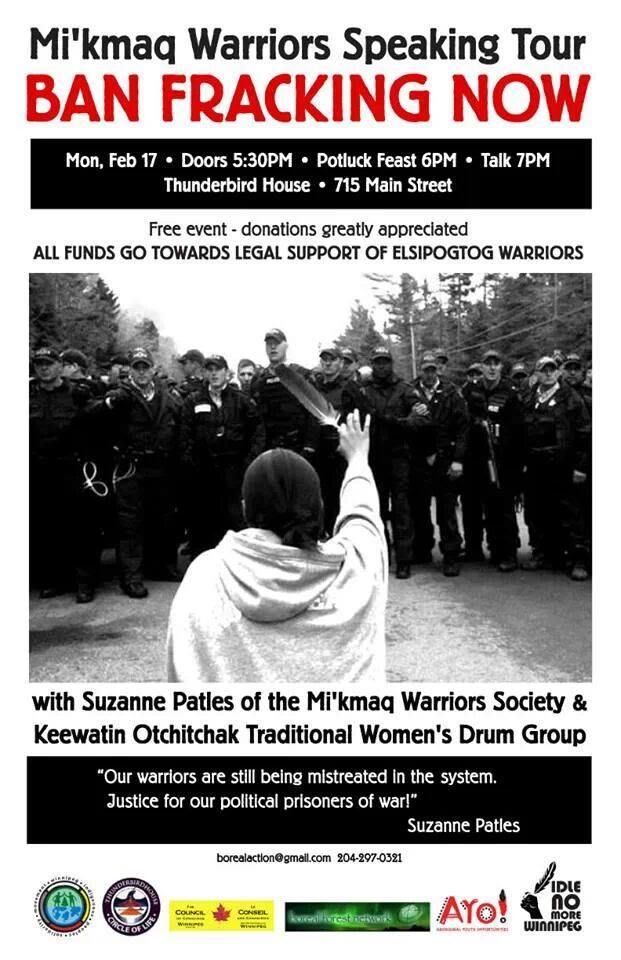
Monday, Feb 17: Mi'kmaq Warriors Speaking Tour

http://ayomovement.files.wordpress.com/2014/01/1618450_10153779648745576_597292072_n.jpg


- Submitted by Karla

Pipeline rupture report raises questions about TransCanada inspections


2011 report criticized TransCanada’s ‘inadequate’ inspections


A CBC News investigation has unearthed a critical report that the federal regulator effectively buried for several years about a rupture on a trouble-prone TransCanada natural gas pipeline.

On July 20, 2009, the Peace River Mainline in northern Alberta exploded, sending 50-metre-tall flames into the air and razing a two-hectare wooded area.

Pipeline rupture
On July 20, 2009, the Peace River Mainline in northern Alberta exploded, sending 50-metre-tall flames into the air and razing a two-hectare wooded area. (Courtesy of Dene Tha' First Nation)

Few people ever learned of the rupture — one of the largest in the past decade — other than the Dene Tha’ First Nation, whose traditional territory it happened on.

In an early 2011 draft report about the incident, the National Energy Board criticized TransCanada, the operator of the line owned by its subsidiary NOVA Gas Transmission, for “inadequate” field inspections and “ineffective” management.
Final reports are typically published by the investigative bodies, either the NEB or the Transportation Safety Board, but this report wasn’t released until this January when the CBC obtained it through an access-to-information request.

The NEB said the delay was caused by an “administrative error” when an employee left without transferring the file over.

In a written statement, TransCanada said there's a combination of construction, coating and soil factors that have required an "active pipe integrity program" on this pipeline. The company said it instituted new technologies and new approaches after the rupture that have since prevented a reoccurrence.

You can read the entire article by clicking here.

- Submitted by Gareth 

Wednesday, 15 January 2014

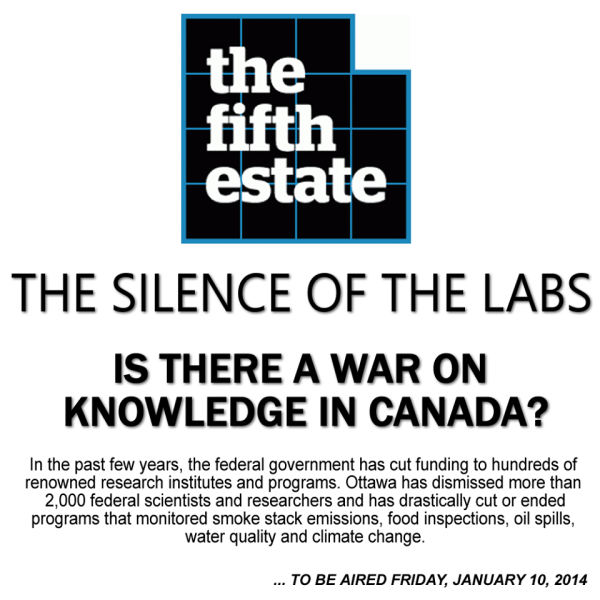
Silence of the Labs, Fifth Estate

http://350orbust.files.wordpress.com/2014/01/silence-of-the-labs.png%3Fw%3D600%26h%3D600

Cori drew a Fifth Estate documentary to our attention at the last meeting called Silence of the Labs.  It focuses on the underfunding and even suppression of science and scientific evidence by our current federal government.  As the result of her having raised this concern in the Just Living group, a sub-group (so far made up of Cori, Michele, Gareth, Kathleen) have agreed to find out more about the impact of these policies are having on the environment, and so much more.  If others, who could not attend the last meeting, are interested in joining this group inquiring into this issue, please let Cori know.

The documentary can by seen by clicking here.

Monday, 23 December 2013

The high price of cheap gas

This article has been reposted from Treehugger.com.  You can read a related article in the Atlantic.

A new study by Lucas Davis shows a wide variance in gas prices, depending on taxation or subsidies.

gas graph
(Copyright: Lucas Davis - Reposted from Treehugger.com)
The figure reveals an enormous amount of variation in gasoline prices. Gasoline prices average $5.26 per gallon, but range from $.09 per gallon in Venezuela to above $9.00 in Turkey and Norway. ... This wide variation in prices is somewhat surprising because crude oil and refi ned products are widely traded internationally, so the opportunity cost of fuels is similar everywhere. Although there are diff erences in transportation, refi ning, and distribution costs, they can explain only a small part of the observed variation in prices. Instead, the more important explanation for the wide variation in fuel prices is that taxes and subsidies diff er widely. Among OECD countries, gasoline taxes per gallon range from an average of $0.49 in the United States, to above $4.00 in Germany and the Netherlands.
Here it is shown another way, from a different study, where the relation of price to consumption is even more stark.


The federal gas tax in the United States has not been raised since 1993. It is supposed to provide the money for the Highway Trust Fund that maintains roads and bridges, but doesn't raise enough. So Congress funds $ 50 billion from general revenue to make up for the shortfall, essentially a giant subsidy that keeps the price of gas low.

- Submitted by Gareth