Sunday, 22 September 2013

Driving is the new smoking

Moe has been focusing on her use of her Smart  Car, as she travelled across western Canada.  She's ready to report on her findings and observations during the Just Living meeting on October 22.  Here's a related article from Treehugger.

In this article, Treehugger's Lloyd Alter comments on a Hush Magazine (Vancouver) article written by Chris Bruntlett.  Alter's piece begins like this:

We have often complained about the negative impacts of our car culture, but Chris Bruntlett, writing in Vancouver magazine Hush, goes much further, calling them selfish, anti-social, unhealthy, and destructive. He says that it is time to start treating cars as the 21st century version of smoking; and picks up on Mikael Colville-Andersen's idea of warning labels for cars. with his own up-to-date designs.

Using cigarette-like warning labels as a starting point, he suggests warning labels on cars that could look like these below.  Perhaps we remember how initially shocking and controversial the cigarette warnings were when they first were used.  Imagine seeing something like this every time we'd get into a car!

wawrning labels
Copyright: Chris Bruntlett; Source: Treehugger

Bruntlett is hard hitting in his critique of the use of cars:

Let’s face it: when someone gets into a car, they are entering a bubble. Not just a physical bubble of metal and glass, but also a figurative one, where all logic and reasoning is barred from entering. They seem oblivious to the simple truth that the motor vehicle is the most inefficient mode of transportation ever devised. Without thinking, they squander millions of years of stored solar energy to haul around two tons of metal, fibreglass, machinery, and electronics, along with their meager frame. This machine demands a colossal amount of space: 300 square feet when parked, and 3,000 square feet when moving at 50 km/hr. As a result, we carelessly hand over vast chunks of our public realm to the parasitic automobile; space that could be put to much better use.

You can read the entire article here.
- submitted by Gareth

Supermarkets should sell more ugly fruits and vegetables


This Treehugger article (Sept 19) connects with Just Living's interest in purchasing ethically.  Karin Martinko writes about all the food that is wasted.  One can't help but notice that all (or at least most) of the produce is aesthetically beautiful, even though how it looks has little to do with its taste or nutrition.  Cucumbers are straight; tomatoes are perfectly shaped, sized and red; carrots don't have "legs".  Where does the oddly shaped produce land up?  Martinko explains that much of it is wasted.


Ugly strawberry
Photo Source: comedy_nose/creative commons
She writes about how her involvement with a CSA (community supported agriculture) required her to adjust her attitude toward oddly shaped produce. Kathleen and I have been part of a CSA for the past number years, and we've also had to adjust to the fact that perfectly nutritious vegetables come in many shapes and colours.


Question:  Should we intentionally be choosing misshapen produce, understanding that if no one takes it from the bin, it'll land in the waste-bin?

The entire article is copied here:

Ever since I signed up for an organic, locally grown CSA (community supported agriculture) share, I’ve had to readjust my perspective on vegetables and understand that they are not as uniformly pretty as supermarkets would have us believe. Tomatoes are not always red, but often orange, yellow, purple, even striped. Carrots and parsnips sometimes have multiple points or shapely-looking ‘legs’ that make them challenging to peel. Unsprayed mustard greens, kale, and arugula can be full of little pinholes from nibbling bugs, but it doesn’t affect their taste or nutrition, just aesthetic appeal. At first it was unnerving getting used to all these strange and bizarrely-shaped vegetables, but now I love them because they’re so different, delicious, and they make a statement.

The world of supermarkets assumes that customers want only perfect, unblemished produce, and that’s why 20-40 percent of all produce in the United Kingdom goes to waste. Much of it can’t even be canned or processed: “Most large processors have advanced contracts with suppliers and often require specific attributes that make the product amenable to processing,” explains the NRDC’s report on the wasteful American food system. An estimated 90,000 tons of produce in the U.K. goes to landfill sites annually, all because customers associate ‘ugly’ with ‘defective.’ Supermarkets aren’t doing much to change this erroneous association, but then it’s also the fault of shallow shoppers: “Customers buy from brimming, fully stocked displays, preferring to choose their apples from a towering pile rather than a scantly filled bin” (NRDC report). If customers are suspicious about half-empty bins, imagine how much more reluctant they would be to buy misshapen vegetables.

There is a growing movement to promote and sell ‘ugly’ produce. This is partly due to necessity. After an unusually cold spring, farmers in the U.K. have a lot of funny-looking vegetables to sell, so many supermarkets say they’ll relax their standards this year. In 2012, Sainsbury committed to taking 100 percent of British farmers’ crops, regardless of appearance. Other people are opting for ugly produce in an effort to reverse the unsustainable practice of throwing it all out. Three German students have begun an “Ugly Fruits” campaign, aimed at getting misshapen produce back into German households. They’d eventually like to see “ugly fruits” supermarkets that sell all the produce rejected by other chains. (Check out this amusing clip they made of ugly produce.) A catering company called Culinary Misfits uses only misshapen produce: “It’s good food that’s even more interesting because it doesn’t exist in the usual supermarket and restaurant range. These vegetables are more like pieces of art,” co-owner Lea Brumsack explained to The Guardian.

Fortunately perceptions can always shift, so the more people who opt for misshapen produce, the more normal and accessible it will become, saving money and cutting back the excessive waste. You might even start to think, as I have, that strange-looking vegetables are more beautiful than the blandly monotonous spectrum of options in the supermarket.

-submitted by Gareth

Saturday, 21 September 2013

Update on the Situation in Bangladesh after Rana Plaza disaster

Victims of the Rana Plaza disaster still waiting for compensation

Almost five months after the collapse of the Rana Plaza building in Bangladesh, only nine of the twenty-nine brands invited to discuss compensation for the victims showed up for a meeting convened by IndustriALL Global Union and chaired by the International Labor Organization (ILO).
» Read more

Bangladesh Center for Worker Solidarity regains legal status

Thanks to international solidarity from trade union and labour rights organizations around the world, as well as pressure from the U.S Department of Labor, the NGO Affairs Bureau of Bangladesh (NAB) has restored the legal status of the Bangladesh Center for Worker Solidarity (BCWS).
» Read more

- submitted by Bev

Farm Tour, Aug 2013 Photos

On August 24, as part of Augustine's summer fundraising program, Just Living hosted a tour to two farms, where the farmers practice ethical farming.  The farms are separate operations, but are farmed by two generations of the same family.  We started with Benjamin Pries, and after lunch visited the farm of Albert and Pam Peters-Pries.  These are just a few pictures of the event, which was enjoyed by all who participated.

Cori and Christine eager to depart
At Benjamin's chicken coop

Benjamin raises turkeys, to be ready for Thanksgiving
Eggs delivered free range

Raising heritage variety pork:  Berkshire

Benjamin explaining the challenges of being a young, sustainable farmer

Albert's garden is his pride and joy.

Albert explains that he decided to become a farmer as a young teen.

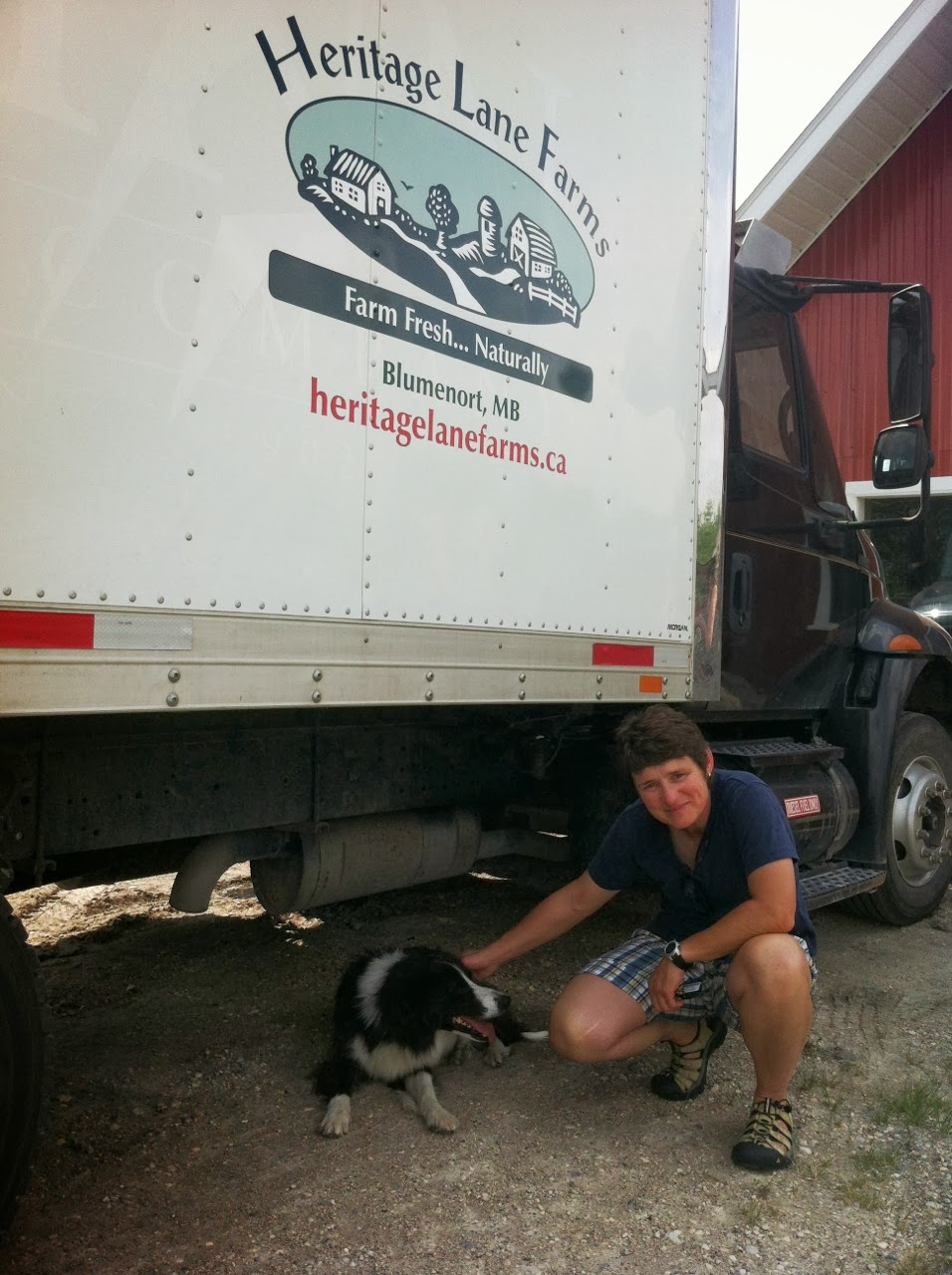
Michele getting close and personal with the farm dog.

Heritage Lane Farms chickens are free range.  No antibiotics or animal-byproducts are used in the process.

Heritage Lane chickens are available at many stores in Winnipeg.


Sunday, 15 September 2013

Augustine's presentation to Bill 18 Hearing

Augustine United  Church Support for Bill 18
August 2013
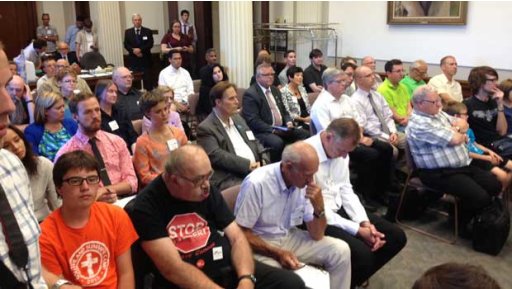
People gathered at the Manitoba legislature on Tuesday evening as hearings into Bill 18 got underway.
Audience gathered on evening of Augustine's presentation (Source: CBC News)

Good evening.  Thank you for this opportunity to speak.  My name is Kathleen Venema and I am here today representing Augustine United Church, where my husband and I are long-time members.  Many of you likely know Augustine as an architectural landmark near the corner of River and Osborne, and one of Winnipeg’s historic churches, originally established in 1887.  Many people may also know that Augustine was the first Affirming United Church in Canada.  Let me provide just a bit of background to explain that designation.  Almost 30 years ago, in 1984, after extensive theological study and discussion, the United Church of Canada specifically affirmed its recognition that all human beings, regardless of sexual orientation, are made in the image of God.  At that point, it issued a call for repentance for the church’s collective history of rejecting homosexual persons.  In 1988, after four more years of study and discussion, the United Church’s General Council affirmed that “all persons, regardless of sexual orientation […] are welcome to be or become full members of the church,” and specifically articulated its readiness to ordain gay and lesbian clergy
[http://www.united-church.ca/exploring/orientation/timeline]. 

In 1995, having been open and supportive of gays and lesbians since the late 1970s, Augustine became the first Affirming United Church Congregation in Canada.  From that point on, Augustine has “intentionally and publicly welcom[ed], recogniz[ed], support[ed], and accept[ed] lesbian, gay, bisexual, transgendered, two-spirited, [and heterosexual] people as full and equal participants in all aspects of life, work, and worship” (2011 JNAC 10).  And we are not alone:  by now there are over 75 Affirming Congregations across Canada [http://www.affirmunited.ca/english/looking.htm]. 

I’ve taken time to sketch this history because we are very aware, at Augustine, of the ways in which some other Christian groups and individuals have characterized and articulated their opposition to Bill 18. 

"Sermon rips anti-bullying bill" (Headline & photo: WFP)

Those oppositions, ostensibly in the name of Christianity, have received a great deal of media attention and for that reason, we agreed that we would take this opportunity to speak to you, and to outline our quite different understanding of Christianity and the Bible.  As Christians, we seek to follow the example of Jesus, whose life, as we learn about it through the New Testament, was characterized by an ethic of love, a radical inclusion of, and standing with, the people in his society who had the least power:  women, children, people impoverished by unjust economic structures, people rendered marginal because of illness and disability, people reviled and disadvantaged because they were from other cultures and religions. 

Photo source:  CTV.News
We understand Jesus to have willingly engaged with these people and to have expressed his allegiance with them.  Indeed, having studied these issues for over thirty years, we understand that our religious and spiritual heritage necessitates our support for the Bill, as part of our active engagement in bringing about a world that welcomes, honours, and supports all the diversity of creation.  

We are also acutely aware of the many ways in which the institutional church has been complicit, throughout history, with wrong, hurtful, and oppressive beliefs and actions.  The Bible is a rich and fascinating and complex historical text, and it has been used and misused many times to defend and sanction social practices that we now recognize as clearly insupportable, among them slavery, sexual slavery, polygamy, the subservience of women, the treatment of women as property, and corporal punishment, of children and others.  We understand current attempts to use the Bible to justify homophobia to be similarly misguided.  As members of an active, searching, studying Christian community that depends for its richness and its vitality on all its diverse individual members, we at Augustine support school cultures where equity, acceptance, respect, and support are extended without prejudice, and where all students’ gifts and energies can be nourished and celebrated.

In closing, we would like to note that we think it is likely that if Jesus were a 21st century Canadian, he would not only support gay-straight alliances, he would be helping to organize the meetings.  For all of these reasons, we would like to unequivocally register our support for Bill 18.  Thank you.


- Submitted by Kathleen

Sunday, 8 September 2013

Sept 20, 21 - Fall Ceremonies at Sandy Saulteaux Centre


To members of the Just Living group,

One of the ideas which we have talked about in the Just Living group is establishing better relations with Aboriginal people. There is an upcoming opportunity to meet in a positive way with Aboriginal people and, in particular, help out and get to know some of our neighbours at the Oak Table.

I am trying to organize a group of people who would like to attend Fall Ceremonies at Sandy Saulteaux Centre by camping out at the Centre (near Beausejour) on Friday September 20 and staying for the celebration on Saturday Sept. 21. There are several people from the Oak Table who would like to do this, but they have no way of getting out on the Friday night. So, if you’re interested, we would meet at Augustine at 6 pm, form partnerships with Oak Table friends, and drive out to camp at the Centre.

That evening, elders Jules and Margaret Lavalee will light the sacred fire and share teachings. Saturday morning, there will be a sunrise ceremony. Then, around 10 pm, about 100 other people – Aboriginal and non-Aboriginal – will arrive. The day is filled with workshops, activities for adults and kids like “Indian baseball”, wandering the grounds, a sweat lodge for those who wish, all ending with a big feast on Saturday night, breaking camp and returning home.

The stated purpose of this weekend is “Feast For Friends – a day to meet each other in friendship, to learn together, to share stories together, to play together, to feast together … to become a people who walk together.” The Sandy Saulteaux Centre is a United Church training facility committed to the idea of walking the two roads: Christianity and traditional Aboriginal teachings. Everything is free, although donations are welcome. For those who can’t camp, the Centre has rooms available for $55.

This will be a real opportunity to form better relations with Aboriginal people. If you’re interested in attending Friday night and Saturday, please phone me at (204) 338-0090.

- submitted by Mike

Menno Simons College Esau Lecture Series


How  we Grow, Share and Eat

Moving Toward Just and Sustainable Food and Farming Systems

Menno Simons College Esau Lecture Series


Fall Public Lectures


ALL Public Lectures 7:00 to 9:00 pm, Eckhardt-Gramatté Hall, The University of Winnipeg


September 26, 2013

Changing Agriculture to Sustain the World: A Sequel
Dr. Martin Entz, University of Manitoba 

Professor Entz is the co-chair of the first Canadian Organic Science Conference, held in Winnipeg in February 2012. He completed his PhD at the University of Winnipeg in drought physiology, and maintains an interest in international development. Entz has done international development work in North Korea and has traveled all of the world’s continents to observe how sustainable agriculture is performed. His research interests include organic cropping systems, long term organic vs. conventional crop production systems, farmer participatory organic crop breeding, crop-livestock integration, and tropical agriculture.

October 24, 2013

Harvest of hope and food sovereignty in northern Manitoba

 Dr. Shirley Thompson, University of Manitoba 

Dr. Shirley Thompson is an associate professor at the Natural Resources Institute, University of Manitoba. Dr. Thompson has a PhD in Adult Education and Community Development and for the last four years and is a board member of Food Secure Canada and the Association of Nonprofit and Social Economy Research. In the past ten years Dr. Thompson has published 18 papers in refereed journals in press or published and one co-edited book as well as a number of videos. Dr. Thompson is working with 4 Island Lake Communities as Principal investigator for traditional land use planning and occupancy studies for sustainable community development. 

November 21, 2013
Feeding the world: is hunger inevitable?
Dr. Haroon Akram-Lodhi, Chair & Professor of International Development Studies, Trent University; and author of: Hungry for Change: Farmers, Food Justice and the Agrarian Question
Trained as an economist, the focus of Dr. Akram-Lodhi's research interest is in the political economy of agrarian change in developing capitalist countries, on the economic dimensions of gender relations, and on the political ecology of sustainable rural livelihoods and communities in contemporary poor countries. Haroon Akram-Lodhi's most recent book is Hungry for Change: Farmers, Food Justice and the Agrarian Question.

- submitted by Ruth


Thursday, 5 September 2013

FAITH IN THE CITY I


FAITH IN THE CITY I
November 1-3, 2013
Sponsored and hosted by
Augustine United Church, 444 River Ave. Winnipeg
in Association with
The Knowles/Woodsworth Centre - University of Winnipeg

Blog Address:  www.faithinthecityaugustine.blogspot.ca

This is Augustine United Church’s first annual ecumenical, congregationally-based conversation, exploring the intersections of a justice-seeking church and urgent social and cultural matters. 

2013 Theme
Following Jesus … into politics?

Focus of conversations:  "To what extent should Christians rely on political engagement to bring about a just and peaceful society?  What is the response of the church, when the political process inevitably falls short in responding to God's call for justice and peace?"

Faith in the City I begins Friday evening (7 p.m.) with a Keynote Address by Bill Blaikie, United Church minister, former MP and MLA, and director of the Knowles-Woodsworth Centre (University of Winnipeg).

On Saturday (9:00 a.m.-4:00 p.m.), four 75 minute sessions provide an opportunity for dialogue between these individuals, but will also involve members of the audience.
    Session 1 explores theological perspectives on the question, involving Jane Barter-Moulaison (Religion and Culture, University of Winnipeg and Anglican priest), Tim Sale (former MLA, Anglican priest) and Gord Zerbe (Theology, Canadian Mennonite University, Author:  Citizenship: Paul, Peace and Politics)
    Session 2 invites Winnipeg activists to speak about their personal activism, as well as their experience with and wishes for the church's engagement in social action.  Featured will be Marianne Cerilli (former MLA, Social Planning Council), Jenny Gerbasi (City Counselor), Kevin Lamoureux (University of Winnipeg, Faculty with ACCESS program), David Northcott (Winnipeg Harvest).
          Lunch, catered by a partner of the Social Purchasing Portal
    Session 3 brings together four voices reflecting divergent perspectives on the question of Christian engagement in politics.  Participating in this conversation will be Bill Blaikie, Allison Chubb (Chaplain, St. John’s College, U of M), Aiden Enns (Geez Magazine publisher) and Lynda Trono (West Broadway Community Minister).
    Session 4 provides opportunity for small group conversations in response to questions like: What's happening in our congregations?  How can we carry this weekend’s conversation forward in our respective faith communities?

On Sunday (10:30 a.m.), all participants are invited to join a special service of worship at Augustine United Church, which will conclude Faith in the City I.

REGISTRATION:             $55 (fully employed); $40 (part-time); $25 (unemployed/student) 
              Early Bird:  Save $10, if registered by September 30 (Note extended Early Bird date).

Lunch will be provided on Saturday.
Child care will be provided on Saturday for children under 4 years of age.
Please mark your calendar in order to participate in this important event. 
Registration forms will be available online by mid-September.
For more information contact the office at Augustine United Church
(augustine.uc@mymts.net; phone: (204) 284-2250).

Monday, 26 August 2013

Go ahead, ruin the planet, just don't ruin the view

Image source:  CBC.ca
The Winnipeg Free Press ran this column by Gwynne Dyer on Monday, August 26.  Dyer writes about the leadership Ecuador has shown in protecting their ecosystem, including being the first country to include the "rights of nature" in its new constitution.  He also shows how the rest of the world hasn't participated in Ecuador's creative approach that may "ultimately bear much fruit", but so far is "just too great an intellectual and political leap".

Dyer's column concludes by reporting the contrast between Ecuador's courageous attempts to protect the environment and the Conservatives in  Great Britain, who have expanded fracking across the country without any regulation regarding the minimum distance between fracking rigs and people's houses.  On the other hand, local people in Britain have a veto when wind turbines are being considered for their neighbourhood.  The contrast between Ecuador and Britain explains the column title:  "Go ahead, ruin the planet, just don't ruin the view".

The first paragraph of the print edition wasn't included in the online article.  It has been included in this post.

"The world has failed us," said Ecuador President Rafael Correa.  "I have signed the executive decree for the liquidation of the Yasuni-ITT trust fund and with this, ended the initiative."  What might have been a model for a system that helps poor countries avoid the need to ruin their environment in order to make ends meet has failed, because the rich countries would not support it. 
In 2007, oil drillers found a reservoir of an estimated 846 million barrels of heavy crude in Yasuni National Park, in Ecuador's part of the Amazon. But the park is home to two indigenous tribes that have so far succeeded in living in voluntary isolation -- and it is listed by UNESCO as a world biosphere reserve. A single hectare of Yasuni contains more species of trees than all of North America. Ecuador, which cannot access finance on international markets, desperately needs money, and the oil meant money: an estimated $7.2 billion over the next decade. Nevertheless, Ecuadorians were horrified by the pollution, deforestation, and cultural destruction the drilling would cause. A large majority of them opposed drilling in the park. And then Energy Minister Alberto Acosta had an idea.
What if Ecuador just left the oil in the ground? In return, Acosta hoped the rest of the world would come up with $3.6 billion (half of the forecast income from oil revenues) over the next decade, to be spent on non-polluting energy generation such as hydroelectric and solar-power schemes and on social programmes to help Ecuador's many poor.
The payoff for the foreign contributors to this fund would come mainly from the fact the oil under Yasuni would never be burned, thereby preventing more than 400 million tonnes of carbon dioxide from going into the atmosphere. Only a drop in the bucket, perhaps, but if the model worked it could be applied widely elsewhere, offering the poor countries an alternative to selling everything they can dig up or cut down.
The idea won the support of the United Nations Development Programme, which agreed to administer the Yasuni-ITT trust fund. It was set up in 2009, and the money started to come in. But it didn't flood in; it just trickled.        ...

To read the entire column, click here. 


- Submitted by Gareth

Tuesday, 13 August 2013

Knowles-Woodsworth Lecture (October 23, 2013)

Information posted on the Knowles-Woodsworth Centre blog by Bill Blaikie (Director).

"I am pleased to post that the annual Knowles-Woodsworth lecture this year will be given by Allan Gregg, well known Canadian political pollster, advisor, and commentator.  Mr. Gregg has had occasion to  express concern about the attitude of the current federal government toward science and evidence based policy making, and the lecture this fall will be an opportunity for him to comment further about these concerns. The lecture will take place on Thursday October 23rd, and will be entitled, as the heading of the blogpost suggests: Religion, Reason and the Public Good. Location TBA.  My thanks to Allan Gregg for accepting the invitation of theKnowles-Woodsworth Centre."

Note:  Bill Blaikie is the keynote speaker and co-planner of Augustine's first annual Faith in the City conversations, scheduled for November 1-3, 2013.  This year's theme:  "Following Jesus ... Into Politics?"  Bill is also the author of The Blaikie Report:  An Insider's Look at  Faith and Politics.

Wake up to the aboriginal comeback

John Ralston Saul - Source:  Globe and Mail


These excerpts are from the Globe and Mail, August 9, 2013, written by John Ralston Saul.  You can read the whole article here.

When Canadians learn that malnourished aboriginal children were used for nutritional experiments, they cannot really be surprised. Shock is a more plausible reaction. We should never be beyond shock. But not surprised. That would be to feign innocence, when we all know that for more than a century, Canadian authorities of all sorts continually acted badly 
when it came to indigenous peoples. Many Canadians knew this when it was happening. The standard public discourse made these actions possible. These were our governments, our authorities. Our responsibility cannot be denied.

What’s more, this will not be the last shocking revelation. There must be much more to come.
And so an official national apology was a good thing. But it will not be nearly enough. For a start, everything must come out and be made clear. Full responsibility, whatever that involves, must be taken. The political, legal and bureaucratic cringing, prevarication, negotiating over which documents to release, when, in what conditions, only make the whole tragedy more humiliating for all Canadians, aboriginal and otherwise. How can any of us agree to live together in any sort of healthy relationship if there is not clarity, as well as full and concrete responsibility taken for the past?
..........
 I have never heard a First Nations, Métis or Inuit person say they wanted to be seen primarily as a victim. That would be marginalizing and demeaning. What they want is that their situation be understood. They want responsibility taken. They want to be heard. They want their dignity back.
That is why there is such insistence on respect for the treaties. We are all signatories. We are all treaty people. Those treaty agreements shaped Canada. The landed immigrant becomes a treaty person the instant she or he swears allegiance as a citizen of Canada.
What indigenous peoples are after is their full and proper place on this territory. They are the original founding pillar of everything done here. Their influence on the shape and habits of this country has been and remains enormous.
..........
The simple truth is that we are all witnesses to the remarkable comeback of the aboriginal peoples. This will mean fundamental shifts in power, in financing and in how we all live together. We can pretend this is not happening; we can manoeuvre in order to delay it. But it is going to happen. We have everything to gain and nothing to lose by embracing this comeback as living proof of the strength of these cultures and peoples. We are witnessing how central they are to the future of this country.
Now is the time to listen to what they are saying and understand what they are calling for.
- Submitted by Gareth

Thursday, 1 August 2013

Mourning for the Earth

To confront climate change, we may need to first deal with our grief.


Photo Credit: Erik Mark Sandberg (Sojouners)

WHY IS IT so hard for people to respond effectively to the reality of climate change?
Changing people’s minds—with facts, tables, and predictions—has proven extremely difficult. Even showing people the miraculous beauty of the planet alongside the predicted losses is not working. Guilt, anxiety, and anger can be motivating forces, but they have debilitating side effects: They are all soul-destroying.
So I wonder about our hearts. Have we ignored our emotional and spiritual connections to the planet? Could the noise swirling around climate change—science, politics, media blitzes, as well as the weather disasters themselves—drown out the voice of a loss so profound that it rests unnamed in our souls? Could our breaking hearts be part of the reason we are immobilized?

These are the questions Katharine M Preston speaks to in her Sojourners article "Mourning for the Earth" (August 2013).  She invites people of faith to understand that grief is a process, not a state of being, and that the well-known stages of grieving (made familiar by E. Kuebler-Ross) can equip us to move through the profound losses related to climate change.

Preston writes that many turn to faith communities in moments of grief.  She asks:  Could churches help us work through our grief so we can embrace the radical changes that must be made.

The article concludes with this quote from the Talmud (attributed):   Do not be daunted by the enormity of the world’s grief. Do justly, now. Love mercy, now. Walk humbly, now. You are not obligated to complete the work. But neither are you free to abandon it.

You can read the entire article here.

-submitted by Gareth